Five ways technology is transforming the business sector – EdTech Innovation Hub

Five ways technology is transforming the business sector – EdTech Innovation Hub

The world of business is forever changing and when it comes to improving productivity and helping small businesses get a leg up in the industry, technology is assisting with everything we do as a business.

With that being said, there are certainly plenty of ways in which technology can transform the way you do business this year. Here are five ways technology is transforming the business sector, one software at a time.

Nowadays businesses rely on storage to keep all of their data and information in one place. Traditionally this storage was kept within business premises in files and file drawers. However, with the internet, the way we keep files has changed. We rely on the cloud now, as well as other storage options like a Yansen industrial solid state drive for those who need access to data quickly.

As a result, it saves on physical storage and often provides a more secure option to keep your information and files safe from aging or from being destroyed by accident.

Automation has transformed the way we do business, especially when it comes to streamlining processes that would otherwise take a lot longer to do.

With automation, you have a great deal of technology that uses this machine learning method to take on tasks that would otherwise be monotonous. You’ll have likely come across some form of automation in your business with the tools you currently use and if not, now is the time to embrace it.

Digital transformation is a great way to bring your business into the modern day. Whether it’s going paperless or spending more of your marketing spend on digital advertising, the world of business is certainly moving towards the digital market in more ways than one.
For existing businesses that have been kicking around for some time, it’s well worth looking into digital transformation and how it might help you modernise your business for the sake of keeping up with the competition.

Cost management is an important one and is great when you need to reduce costs within your business operations.
With the cost of living crisis and other economic struggles that businesses have faced since the pandemic, new technologies like AI and data processing have been integral to help increase the potential of existing resources, rather than spending money on new ones.
By saving money or identifying where money is perhaps not being spent enough, businesses are able to improve upon their decision-making. That hopefully helps to leverage their finances in a way that more success can be found as a result.

Collaborative tools are important to have for the purpose of communication. Too many businesses struggle with keeping in touch with their colleagues, never mind the clients they work for. Collaborative tools that house tasks and communications all in one place help boost productivity levels while holding employees accountable for their workloads.

Technology is changing in many ways and advancing to heights most people would have not thought possible. Who knows what’s around the corner?

Five ways technology is transforming the business sector – EdTech Innovation Hub Read More »

Blockchain for Sustainable Supply Chains Market Size – 2032 – Allied Market Research

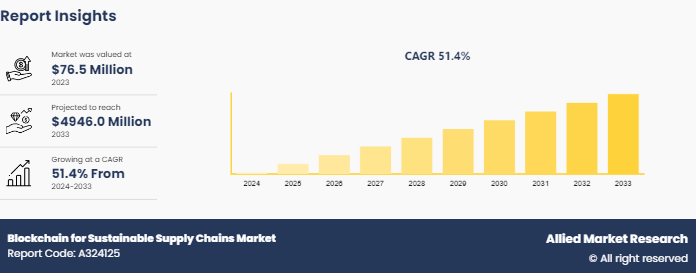
The global blockchain for sustainable supply chains market was valued at $76.5 million in 2023, and is projected to reach $4,946.0 million by 2033, growing at a CAGR of 51.4% from 2024 to 2033. Increasing consumer awareness and preference for sustainably sourced products drive the adoption of blockchain for enhancing transparency and traceability in supply chains.

Blockchain for Sustainable Supply Chains Market

The Blockchain for Sustainable Supply Chain market is a dynamic and rapidly evolving sector within the technology industry. It encompasses a wide range of software solutions and services designed to help organizations create, manage, and optimize digital experiences for their customers. Blockchain for Sustainable Supply Chain platforms integrate various digital tools such as content management systems, customer relationship management software, e-commerce platforms, and analytics tools. These integrations enable businesses to deliver personalized, engaging, and consistent experiences across multiple digital channels. Organizations increasingly recognize the importance of providing exceptional digital experiences to enhance customer engagement and build brand loyalty. Consequently, there is a rising demand for Blockchain for Sustainable Supply Chain solutions across industries. Businesses are investing in these platforms to enhance their online presence, improve customer interactions, and drive business growth. Key drivers of the Blockchain for Sustainable Supply Chain market include the growing focus on customer experience, the proliferation of digital touchpoints, the need for seamless omnichannel experiences, and the rise of data-driven marketing strategies. These factors underscore the market’s evolution towards more integrated and customer-centric supply chain management practices enabled by blockchain technology.

The blockchain for sustainable supply chain market study covers 20 countries. The research includes a segment analysis of each country in terms of value ($Million) for the projected period 2023-2033.

More than 1, 500 product literatures, industry releases, annual reports, and other such documents of major blockchain for sustainable supply chain industry participants along with authentic industry journals, trade associations’ releases, and government websites have been reviewed for generating high-value industry insights.

The study integrated high-quality data, professional opinions and analysis, and critical independent perspectives. The research approach is intended to provide a balanced view of global markets and assist stakeholders in making educated decisions to achieve their most ambitious growth objectives.

According to 2023 Digital Trends in Supply Chain Survey of PWC, most executives agreed or strongly agreed that their supply chain strategy and operations are important to executing their company’s environmental, social and governance (ESG) strategy (86%) . Most also said their digital investments in ESG have benefited their supply chains as well (79%) . But many have yet to develop key digital capabilities.

According to an article published in Financial Express on March 2024 by Prof. A Seetharaman, blockchain technology helps in addressing the issues of the supply chain ecosystem by bringing all stakeholders such as raw material suppliers, manufacturers, distributors, wholesalers, retailers, and end-users/consumers onto the same platform. Usage of smart contract features of Blockchain platform coupled with IoT & AI in logistics and supply chain area enables predictive maintenance resulting in better logistics solutions.
The rapidly evolving market for Blockchain for Sustainable Supply Chains is shaped by several key drivers, constraints, and opportunities. Primarily, the emphasis on enhancing consumer experiences drives the adoption of blockchain solutions. Businesses recognize the importance of personalized, seamless, and engaging digital interactions to attract and retain customers in competitive markets. In addition, digital transformation across industries propels the adoption of blockchain, aiming to boost productivity, foster collaboration, and optimize digital strategies effectively. Technological advancements, particularly in artificial intelligence and data analytics, drive innovation in blockchain for sustainable supply chains. These innovations empower organizations to enhance digital experiences and gain deeper insights into consumer behavior, further fueling market growth. However, integration complexities pose significant challenges for businesses deploying blockchain solutions. The intricacies of integrating blockchain with existing systems and processes can hinder seamless implementation. Moreover, security concerns related to data privacy and regulatory compliance require robust security measures to protect sensitive information. Despite these challenges, promising opportunities abound. Providers capitalize on the growing demand for personalized digital experiences by offering tailored solutions that meet specific customer needs and preferences. Furthermore, the expansion of digital technology in emerging markets presents new opportunities for market penetration and growth. Organizations that effectively leverage these drivers, address constraints, and seize opportunities can navigate the blockchain for sustainable supply chain market successfully, driving growth and achieving business success. Furthermore, the blockchain for sustainable supply chain market holds promise despite these challenges. Providers can leverage the growing demand for personalized digital experiences by offering customizable solutions tailored to individual customer needs. In addition, the expansion of digital technology in developing nations presents new opportunities for market penetration and growth. As businesses across these regions embrace digital transformation, the demand for enhanced digital experience solutions is set to rise, fostering innovation and expanding market reach. By effectively navigating these dynamics—leveraging drivers, addressing constraints, and seizing opportunities—organizations can capitalize on the transformative potential of blockchain for sustainable supply chains to drive growth and achieve sustainable success in the global marketplace.

The Blockchain for Sustainable Supply Chain market operates within the broader context of supply chain management and sustainability initiatives. It encompasses technologies and solutions aimed at enhancing transparency, traceability, and ethical practices across global supply chains. Businesses adopt blockchain to securely record and validate transactions, ensuring authenticity and compliance with environmental and social standards throughout the supply chain journey. Within this market, Blockchain for Sustainable Supply Chain solutions integrate blockchain technology with supply chain management practices to improve efficiency, reduce costs, and mitigate risks associated with traditional supply chain processes. These solutions enable real-time tracking of products, verification of origin and quality, and compliance with regulatory requirements. By leveraging blockchain’s decentralized ledger, businesses can enhance trust among stakeholders, streamline operations, and foster sustainable business practices.

The Blockchain for Sustainable Supply Chain market addresses growing concerns about ethical sourcing, environmental impact, and regulatory compliance. It supports industries in meeting consumer demands for transparency and sustainability, driving adoption across various sectors including retail, manufacturing, and agriculture. As businesses prioritize sustainable practices and regulatory adherence, the demand for blockchain solutions continues to grow, fueling innovation and transformation within global supply chains. Key drivers include increasing regulatory pressures, consumer awareness of sustainability issues, and advancements in blockchain technology. However, challenges such as integration complexities and data security concerns remain significant considerations for businesses deploying blockchain solutions. Despite these challenges, the market offers promising opportunities for providers to deliver tailored solutions that meet evolving industry needs and drive sustainable growth. As organizations navigate the complexities of modern supply chains, Blockchain for Sustainable Supply Chain solutions emerge as essential tools for enhancing operational transparency, ensuring ethical practices, and maintaining competitive advantage in a global marketplace increasingly focused on sustainability and responsible business practices.

The blockchain for sustainable supply chain market is segmented into enterprise size,  industry vertical and region. Depending on eterprise size, the market is bifurcated into large enterprise and SMEs. Depending on industry vertical, the market is segregated into retail, manufacturing, food and beverages, healthcare, oil and gas and others. Region wise, the market is analyzed across North America, Europe, Asia-Pacific, and LAMEA.

North America stands at the forefront of the Blockchain for Sustainable Supply Chains market, propelled by its advanced digital infrastructure and widespread adoption of blockchain technologies across various sectors. In the U.S., industry leaders in retail, manufacturing, and agriculture are increasingly leveraging blockchain to enhance supply chain transparency, ensure ethical sourcing practices, and comply with stringent regulatory standards. This adoption is driven by the region’s robust technological ecosystem and a strong emphasis on sustainability initiatives. Canada similarly embraces blockchain solutions within its supply chains, with businesses focusing on traceability, efficiency improvements, and sustainable practices. Supported by government initiatives promoting innovation and environmental stewardship, Canadian industries, particularly in natural resources and logistics, integrate blockchain to bolster their supply chain operations and meet evolving consumer demands for transparency and accountability. Key drivers in North America include regulatory frameworks advocating for sustainability, consumer preferences for ethically sourced products, and ongoing technological advancements in blockchain. These factors underscore a growing commitment among businesses to adopt blockchain solutions that enhance operational efficiency and build consumer trust through transparent supply chain practices.

Innovations in blockchain technology, coupled with increasing industry collaborations and regulatory support, are expected to drive further adoption and expansion across the region. As businesses strive to meet sustainability goals and regulatory requirements, blockchain solutions will play a pivotal role in shaping the future of transparent and efficient supply chain management in North America. In addition, the North America area has a large and diversified market with unrealized potential, which attracts vendors seeking to grow their regional presence and meet the changing demands of local companies.
In March 2022, Unilever, a consumer products giant, implemented GreenToken by SAP, a startup that provides blockchain-based technology. GreenToken is a blockchain-based supply chain traceability and chain-of-custody application that allows companies to record and track facts about the raw materials they use in products. This can include information like where raw materials originate, specific production attributes and certifications. GreenToken, which companies access through a SaaS interface dashboard, provides the ability for producers to create a digital token of physical goods that can include multiple attributes, such as the original plantation and any certifications.

In November 2023, Agribusiness giant Bunge teamed up with one of the world’s largest producers of animal feed to develop a blockchain technology for ensuring soy and other products are deforestation-free. The memorandum of understanding with BKP is meant to “transform traceability data from the field to final customers.” The agreement also involves the possibility of future collaboration on other services, including further integration with a focus on real-time data transfer and measuring the carbon footprint of traded volumes.
The major players operating in the blockchain for sustainable supply chain market include IBM, Microsoft, SAP, Oracle, Accenture, and Dell Technologies. Other players in blockchain for sustainable supply chain market include Walmart, Carrefour, Intel, and VeChain.
In February 2019, Accenture introduced a circular supply chain capability that leverages digital identity, payments and blockchain to directly reward sustainable practices of small-scale growers and suppliers. To build upon this capability, Accenture is working with Mastercard, Amazon Web Services, Everledger and Mercy Corps to explore solutions that empower consumers, enable transparency and promote financial inclusion for small-scale producers. The circular supply chain capability is intended to meet this need by combining blockchain, digital identity and payments technologies to allow customers to identify individual producers who use sustainable methods and financially reward them with a “tip” made by direct payment. In addition to empowering customers and connecting them with small-scale producers, the capability is designed to enable producers, manufacturers and retailers to better manage their inventory and reduce waste; creates better transparency across the supply chain; ensures the authenticity of produce; and provides producers with more-equitable compensation for their produce by enabling consumers to reward them directly.

This report provides a quantitative analysis of the segments, current trends, estimations, and dynamics of the blockchain for sustainable supply chain market analysis from 2023 to 2033 to identify the prevailing blockchain for sustainable supply chain market opportunities.
Market research is offered along with information related to key drivers, restraints, and opportunities.
Porter’s five forces analysis highlights the potency of buyers and suppliers to enable stakeholders to make profit-oriented business decisions and strengthen their supplier-buyer network.

In-depth analysis of the Blockchain for sustainable supply chain market segmentation assists to determine the prevailing market opportunities. Major countries in each region are mapped according to their revenue contribution to the global blockchain for sustainable supply chain market statistics.

Market player positioning facilitates benchmarking and provides a clear understanding of the present position of the market players.
The report includes the regional and global blockchain analysis for sustainable supply chain market trends, key players, market segments, application areas, and market growth strategies.

The report profiles IBM, Microsoft, SAP, Oracle, Accenture, and Dell Technologies. Other players in the blockchain for sustainable supply chain market include Walmart, Carrefour, Intel, and VeChain.

The key growth strategies of Blockchain for Sustainable Supply Chain Market players include expanding their product portfolios, mergers and acquisitions, agreements, geographical expansion, and collaborations.


Blockchain for Sustainable Supply Chains Market Size – 2032 – Allied Market Research Read More »

Can IoT eliminate the need for ERP and MES in manufacturing? – TechRepublic

Register for your free TechRepublic membership or if you are already a member, sign in using your preferred method below.
We recently updated our Terms and Conditions for TechRepublic Premium. By clicking continue, you agree to these updated terms.
Invalid email/username and password combination supplied.
An email has been sent to you with instructions on how to reset your password.
By registering, you agree to the Terms of Use and acknowledge the data practices outlined in the Privacy Policy.
You will also receive a complimentary subscription to TechRepublic’s News and Special Offers newsletter and the Top Story of the Day newsletter. You may unsubscribe from these newsletters at any time.
Username must be unique. Password must be a minimum of 6 characters and have any 3 of the 4 items: a number (0 through 9), a special character (such as !, $, #, %), an uppercase character (A through Z) or a lowercase (a through z) character (no spaces).
Can IoT eliminate the need for ERP and MES in manufacturing?
Your email has been sent
How a simple understanding of how systems work can pave the way to IoT and manufacturing success.
The Internet of Things is a major driver of Manufacturing 4.0—also known as the Fourth Industrial Revolution—a digitalization initiative that began in Germany in 2015 and has propelled thousands of sensor, robotics and automation projects in manufacturing and warehousing. The ability to obtain real-time information about an imminent failure of a machine on a production line or to use a robot instead of a human to cut metal, plastic, wood or granite to size, has enthused manufacturers so much that some are beginning to wonder whether they can get rid of what they perceive as old and clunky enterprise resource planning and manufacturing execution systems.
SEE: Edge computing adoption to increase through 2026; organizations cautious about adding 5G to the mix (TechRepublic Premium)
Unlike ERP and MES, IoT that is hooked into every manufacturing and warehouse operation can report on real-time events. It can issue alerts and affect machine-to-machine communications to facilitate production line automation. So, if IoT can do all of these things and in real time, why use older legacy systems that can’t?
The feeling that IoT could supplant traditional systems like MES and ERP began with users on shop floors who got excited about all of the real-time automation and reporting IoT systems could do. It was natural to wonder if IoT could do even more.
IoT can and will do more in the future that it does today, but that doesn’t mean that it can supplant ERP or MES because these systems were built to do different things that IoT can’t do well.
Often referred to as the “drive chain” of enterprises, an ERP system is all-encompassing. ERP has software modules that support manufacturing, engineering, planning, purchasing, accounting, service, HR, etc. ERP’s value rests in its ability to integrate enterprise information processing across all departments. The security in ERP systems is extremely robust. ERP’s reporting and analytics capabilities are well developed. Most ERP systems also have middleware that assists ERP in integrating with IoT.
SEE: Future of farming: AI, IoT, drones, and more (free PDF) (TechRepublic)
MES is also a series of software modules that are closely linked with each other—only MES focuses exclusively on manufacturing and shop-floor operations. Like ERP, MES systems have robust security and extensive reporting capability. They can also communicate with IoT devices.
The advantages that IoT has over ERP and MES are its ability to communicate with edge sensors and services, capture and process unstructured data, trigger events in real time and communicate between different devices and networks on the manufacturing floor.
The advantages that ERP and MES have over IoT are much sounder security, large data repositories that can handle a variety of queries and analytics, and the ability to interface with myriad business processes across the company (e.g., manufacturing, planning, finance, service marketing, HR and more).
At the end of the day, IoT is a more specialized technology that can automate business processes that use robotics and other IoT end devices, and it can deliver results in real time—but ERP and MES are still the mainstay systems of organizations, with IoT being a critical real-time data “feeder” network into these larger systems.
Explaining how different systems work together and why they are all necessary is an important talking point for IT leaders as more organizations adopt IoT because if the different roles of IoT and other systems aren’t clearly explained, there is a risk that people could expect more out of IoT than it can deliver.
If IT can give executive management and business users a better understanding of overall IT architecture and its different system components—including IoT—these plain-English explanations will go a long way in furthering general understanding of systems and paving the way for IoT project success.
Stay informed about smart cities tech, which includes innovations in IoT, 5G, security, data analytics, mobile apps, and more.
Can IoT eliminate the need for ERP and MES in manufacturing?
Your email has been sent
Your message has been sent
TechRepublic Premium content helps you solve your toughest IT issues and jump-start your career or next project.
Encryption software protects confidential and private data in transit and at rest by making it accessible only to authorized individuals. Learn about the best encryption software and techniques.
Users can access several key Microsoft applications with keyboard shortcuts and a standard keyboard, but increased efficiency is limited without some special tricks.
Jack Wallen takes on the age-old question of what Linux needs to succeed on the desktop. This time around, his answers have nothing to do with software.
Want to enhance and highlight your IT skills? A tech-focused certification might do the trick. These top IT certification prep tools can help.
Ethisphere has released its annual edition of the most ethical companies from a variety of industries.
Recruiting an IoT architect with the right combination of technical expertise and experience will require a comprehensive screening process. This hiring kit from TechRepublic Premium includes a job description, sample interview questions and a basic want ad that you can customize for your business to find, interview, recruit and hire the best candidates for an …
This hiring kit from TechRepublic Premium contains a job description, sample interview questions and a basic want ad to help you find, interview, recruit and hire the best candidates for an open FinTech Engineer position. From the hiring kit’s introduction: Over the past decade or so, particularly after the general proliferation of smartphones at the …
This hiring kit from TechRepublic Premium contains a job description, sample interview questions and a basic want ad to help you find, interview, recruit and hire the best candidates for an open Virtual Reality Designer position. From the hiring kit’s introduction: While the concept of virtual and augmented reality applications has been around for decades, …
It’s critical to plan Microsoft 365 apps and services deployments on Macs properly to avoid end-user frustrations. There are so many elements to consider that forward-thinking IT professionals should consider employing a checklist. With proper administration, IT departments can ensure important tasks aren’t overlooked, and users don’t need to return systems to the help desk …

source

Can IoT eliminate the need for ERP and MES in manufacturing? – TechRepublic Read More »

New Project to Support the Emergence of a Digital Economy in Djibouti – World Bank Group

With 189 member countries, staff from more than 170 countries, and offices in over 130 locations, the World Bank Group is a unique global partnership: five institutions working for sustainable solutions that reduce poverty and build shared prosperity in developing countries.  
The World Bank Group works in every major area of development.  We provide a wide array of financial products and technical assistance, and we help countries share and apply innovative knowledge and solutions to the challenges they face.
We face big challenges to help the world’s poorest people and ensure that everyone sees benefits from economic growth. Data and research help us understand these challenges and set priorities, share knowledge of what works, and measure progress.
WASHINGTON, December 2, 2021 – The World Bank today approved a US$10 million credit from the International Development Association (IDA), the World Bank’s program for the poorest countries, in support of Djibouti’s efforts to accelerate the digital transformation and build a more inclusive digital economy.
While Djibouti has made significant inroads in becoming a digital hub in regional connectivity and data markets, many Djiboutians do not fully benefit from the country’s connectivity infrastructure. The new Digital Foundations Project aims to ensure that more citizens and businesses have access to quality and affordable internet by developing an enabling environment for the gradual introduction of competition and private-sector investment in information and communication technology (ICT), and by fostering the uptake of digital skills and services. The project is aligned with the new Country Partnership Framework and Djibouti’s Vision 2035, which recognize the role of ICT in economic growth.
Accelerating digital transformation in Djibouti is an urgent necessity for post-COVID-19 recovery,” said Ilyas Moussa Dawaleh, Djibouti’s Minister of Economy and Finance in charge of Industry. “Stimulating economic growth, innovation and job creation through technology is an opportunity that will benefit present and future generations.
The new financing will strengthen the capacity of the public sector, specifically the Ministry of Communication, with responsibility for Posts and Telecommunications, the Delegate Ministry in charge of Digital Economy and Innovation and the Multi-sectoral Regulatory Authority of Djibouti, to promote digital economy and market competition. It will provide support to micro, small and medium enterprises (MSMEs), while boosting Djibouti’s resilience to external shocks, including disaster response and climate monitoring.
COVID-19 has highlighted the importance of digital technologies,” said Boubacar-Sid Barry, World Bank Resident Representative in Djibouti. “With this new project, the Bank supports Djibouti in its efforts to address vulnerabilities and create a favorable environment for the development of an inclusive and safe digital economy.
The project will also support the development of digital skills programs for entrepreneurs and the integration of basic digital skills into school and university curricula. It is anticipated that the project will benefit all segments of Djibouti’s economy and society, including the public and private sectors, women, youth and underserved rural populations. Citizen engagement will be an essential component of the program.
According to Eric Dunand and Tim Kelly, co-Task Team Leaders, “The project will help Djibouti to harness its digital potential. A high-performing digital economy in Djibouti, based on a well-developed ICT sector, will have many benefits. Wider use of digital technologies will help the government improve service delivery, offer youth more job opportunities, and entrepreneurs, more business prospects in diversified economic sectors.
The World Bank’s portfolio in Djibouti consists of 14 projects totaling US$258 million in financing from IDA. The portfolio is focused on education, health, social safety nets, energy, rural community development, urban poverty reduction, the modernization of public administration, governance, and private sector development with an emphasis on women and youth.

source

New Project to Support the Emergence of a Digital Economy in Djibouti – World Bank Group Read More »

Capacity building to boost science in Ethiopia – Nature.com

Thank you for visiting nature.com. You are using a browser version with limited support for CSS. To obtain the best experience, we recommend you use a more up to date browser (or turn off compatibility mode in Internet Explorer). In the meantime, to ensure continued support, we are displaying the site without styles and JavaScript.
Advertisement
Kendall Powell is a freelance writer in Boulder, Colorado.
You can also search for this author in PubMed  Google Scholar
You have full access to this article via your institution.

Aster Tsegaye encourages young researchers to apply for opportunities to work in overseas laboratories and with high-tech equipment.Credit: Maheder Haileselassie for Nature
In the sixth of eight articles about the career experiences of female scientists in Africa, Aster Tsegaye, an immuno-haematology researcher at Addis Ababa University and a fellow of the Ethiopian Academy of Sciences, describes how her mother’s support and encouragement enabled her to study abroad. She also offers advice on how to work during political unrest.
When I graduated from Addas Ababa University with a biology degree in 1987, I was assigned to a haematology laboratory in what was then the Ethiopian National Research Institute of Health (which now forms part of the Ethiopian Public Health Institute). In those days, when you graduated from higher education you were assigned a job. I didn’t know anything about haematology. All I knew was that it was an ‘ology’.
A lesson for the younger generation is that if you don’t get what you like, like what you get. I had to learn on the job from senior lab technicians who were always busy. So, by doing all the ‘busy work’ jobs, such as clerical work and washing lab equipment, I made sure the technicians had time in the afternoons to teach me and check my work. Even though I had a higher academic degree, I admitted my limitations, acknowledged their expertise and respected them. In the evenings, I taught myself from a textbook. Two years later, I was teaching a haematology course at the institute’s School of Medical Laboratory Technology. Next, I started a master’s thesis on anaemia caused by hookworm infection.
At that time, in the mid-1990s, HIV was gripping sub-Saharan Africa. I had a chance to work on the Ethiopia–Netherlands AIDS Research Project, a decade-long collaboration to conduct research on HIV/AIDS, which set up an HIV reference laboratory in Ethiopia and trained Ethiopian researchers in epidemiology. Through that programme, I began my PhD at the University of Amsterdam in 2000. It meant starting when my second baby was 11 months old and my older son was almost 3. My mum, who never finished secondary school, said, “Go for it.” She offered to look after my kids.

Career resources for African scientists
Still, it was hard to leave them. The first time you go away, you can promise them you’ll bring chocolates back. But after that, they beg you not to go. My PhD was a sandwich programme, which meant spending three months in Amsterdam and nine months in Ethiopia for each of the four years.
Now, there are opportunities to do a PhD in Ethiopia, but I think having exposure and experience in international laboratories, and working with other scientists and with high-tech equipment is important. I would advise young researchers to develop their research and then apply for grants or scholarships for international opportunities.
Doing science is even more challenging amid unrest, but we should contribute to peace and stability wherever we can. It’s important not to panic and to stay calm. Social media should be used to promote peace and not to disseminate negative or fake news.
Whatever challenge we have, there is always a solution. When I returned to Addis Ababa University in 2007 and joined the school of medical laboratory sciences as a professor, it was one of the least-equipped schools on campus. I proposed that we standardized what we were teaching on our courses across other major universities in Ethiopia for training medical lab professionals to work on HIV/AIDS, and we did that in partnership with the American Society for Clinical Pathology based in Chicago, Illinois.
Although I’ve had opportunities to work in high-tech labs, I preferred to build the capacity of my department here. I am a firm believer in capacity building. We convinced management at the Centers for Disease Control and Prevention in Ethiopia (the US public-health agency established a presence here in 2001) that our students needed hands-on experience. I coordinated the procurement and distribution of immune-cell-count analysers and clinical chemistry equipment to eight universities that taught medical laboratory science. I didn’t build my own lab, but I’m satisfied with what I did at that stage, because now we are harvesting that expertise.

Nature 603, 190 (2022)
doi: https://doi.org/10.1038/d41586-022-00401-2
This interview has been edited for length and clarity.
Career Column
Editorial
Career Column
Outlook
World View
Editorial
Outlook
Outlook
Outlook
SRM University
Mangalagiri, India
City University of Hong Kong (CityU)
Hong Kong, China
Luxembourg Institute of Health (LIH)
Strassen, Luxembourg
The University of British Columbia (UBC)
Vancouver, Canada
You have full access to this article via your institution.

An essential round-up of science news, opinion and analysis, delivered to your inbox every weekday.
Sign up for the Nature Briefing newsletter — what matters in science, free to your inbox daily.
Advanced search
Nature (Nature) ISSN 1476-4687 (online) ISSN 0028-0836 (print)
© 2022 Springer Nature Limited

source

Capacity building to boost science in Ethiopia – Nature.com Read More »

Funding the ERP: Analysis of funding for the implementation of the Education Response Plan (ERP) for refugees and host communities – Uganda – ReliefWeb

Informing humanitarians worldwide 24/7 — a service provided by UN OCHA
Find help on how to use the site, read terms and conditions, view the FAQs and API documentation.
Access your account or create a new one for additional features or to post job or training opportunities.
Latest humanitarian reports, maps and infographics and full document archive.
List of countries covered by ReliefWeb.
List of alerts, ongoing and past disasters covered by ReliefWeb.
List of organizations that are actively providing ReliefWeb with content.
Curated pages dedicated to humanitarian themes and specific humanitarian crises.
Open job opportunities in the humanitarian field.
Open training opportunities in the humanitarian field.
Uganda + 8 more
SUMMARY
Uganda has provided refuge to people from neighbouring countries over many years and currently supports 1,446,378 refugees as of December 2020. While most refugees are from South Sudan and DRC, Uganda also hosts refugees from Burundi, Somalia, Rwanda, Eritrea, Sudan and Ethiopia. According to UNHCR data, 51% of the refugee population is of school going age (3-17 years).
Uganda’s Refugee Act of 2006 provides that refugees should have the same access to elementary education as Ugandan nationals and the same access to further studies as other foreigners living in Uganda. Despite this, in 2018, it was estimated that 57% of refugee children in Uganda (at least 353,000) and 34% of local children in refugee-hosting districts (around 171,000) do not have access to education.
The Education Response Plan for Refugees and Host Communities (Education Response Plan or ERP) was developed to ensure improved learning outcomes for increasing numbers of refugee and host-community children and adolescents across Uganda. The core principle of the ERP was to ensure that all refugee children and adolescents, as well as children within host communities, have access to good quality education at all levels, irrespective of the country of origin of the refugees and their location within Uganda. The ERP was projected to reach 675,000 refugee and host community learners per year, costing USD 389 million over 3.5 years.
The ERP targeted 12 districts of Yumbe, Moyo, Arua, Adjumani, Koboko, Lamwo, Kiryandongo, Kyangwali, Kamwenge, Kyegegwa, Isingiro and Kampala, and 34 sub counties where refugees are settled. It covered all refugee children, adolescents and youth registered by the Office of the Prime Minister (OPM) from South Sudan, DRC, Burundi and other countries as well as the host community children.
This paper assesses financing allocations for the implementation of the ERP for the last 3 years 2018-2021. Oxfam hopes its findings will influence policy planning for the next budget process and encourage the government to direct adequate resources to support the ERP and advance education for refugees.
Ethiopia + 11 more
South Sudan
South Sudan
Somalia
ReliefWeb's blog
ReliefWeb Labs projects explore new and emerging opportunities to improve information delivery to humanitarians.
Learn more about ReliefWeb, leading online source for reliable and timely humanitarian information on global crises and disasters since 1996.
ReliefWeb's terms & Conditions.
Contact us.
Service provided by UN OCHA
OCHA coordinates the global emergency response to save lives and protect people in humanitarian crises. We advocate for effective and principled humanitarian action by all, for all.
ReliefWeb's Terms & Conditions.
© 2022 all rights reserved.

source

Funding the ERP: Analysis of funding for the implementation of the Education Response Plan (ERP) for refugees and host communities – Uganda – ReliefWeb Read More »

The 4 Pillars of Successful Digital Transformations – HBR.org Daily

Digital transformation can mean a lot of different things. For leaders, it can be hard to know where you should be focusing investment — and what kind of digital transformation you’re really after. The authors outline four pillars of digital transformation: IT uplift, digitizing operations, digital marketing, and new ventures. Which pillar is the right starting point for your company depends on your context, needs, but also your digital maturity.
Despite years of discussion, understanding what digital transformation means for established companies remains a daunting challenge. Leaders put in charge of a digital transformation feel pulled in many different directions, with competing demands from IT, marketing, sales, and operations. Without a clear understanding, the wrong people are often put in charge, with the wrong resources, and the wrong KPIs, setting the digital transformation project up for failure.
The key to cutting through the confusion is to see that digital transformation is not a single thing, but a multi-faceted journey with differing goals depending on your industry and digital maturity. Just as we had to evolve our view of computers after their introduction — from a device performing a narrow set of tasks at the edge of the organization to one that performs many tasks, in many different ways — so it is time to evolve our view of digital transformation, from a monolithic concept to understand that digital transformation means many different things for different parts of the organization. Doing so will help you articulate what kind of digital transformation you’re really talking about, and plan accordingly.
Based on our collective research on companies undergoing digital transformation, we offer a simplifying framework to cut through the confusion and conflicting demands. The framework outlines the four pillars of digital transformation we see today: IT uplift, digitizing operations, digital marketing, and digital businesses. All four are part of most companies digital transformation journey. But without understanding how they are different, it’s confusing to understand what to do next or how to invest — the resources, tools, goals, C-Suite sponsors and KPIs required for success are totally different in each case. Being clear about their differing demands can help you make smart tradeoffs and clear progress.
Below we outline the four pillars and how to invest properly to set yourself up for success. Which pillar is the right starting point for your company depends on your context, needs, but also your digital maturity. Typically, companies tackle the first pillars we describe near the start of their digital transformation journey, although as they mature they may continually upgrade to add additional pillars.
For many companies, digital transformation starts with upgrading the company’s IT infrastructure as well as mobile infrastructure, data lakes, and the cloud. Essentially, this is an opportunity to use budget allocated to “digital initiatives” to modernize IT and communications platforms within your enterprise. When completed, an IT uplift provides your company access to up-to-date tools that offer increased employee efficiency, lower IT maintenance costs and increased employee satisfaction.
Some companies are already deep into this journey, but many other companies struggle with questions about how to upgrade the digital infrastructure. Often this is the first step on the digital journey. It requires IT architects and time, but promises up-to-date platforms with more effective tools to serve customers at lower cost of maintenance. But for more mature digital companies, investment is still required to use advanced tools such as artificial intelligence.
Typically, the CIO or CTO should lead this pillar of digital transformation and the KPIs to indicate success are access to new tools, reduced maintenance costs, improved employee satisfaction, and better business performance. In support of this, recent research from IDC indicates that organizations which had begun an ERP cloud migration as part of a digital transformation initiative prior to the COVID-19 pandemic fared far better than organizations that didn’t.
A second critical pillar of digital transformation, often tackled earlier in the digital transformation journey, is using digital for optimizing, simplifying, and rationalizing existing processes. The goal here is to use digital tools, including more advanced technologies such as AI, 5G, and IOT, to streamline business growth.
In its most basic form, this pillar can mean swapping out analog activities with digital ones. But other times it involves rearchitecting the system to meet the needs of today customers. For example, in the past when PayPal sent payments via email, they had significant time to ensure regulatory compliance. But to enable the instant payments demanded in today’s market required rearchitecting the PayPal’s organization, merging once separate divisions for payments and compliance into one entity. This is more than just swapping analog processes for digital ones; it is about rearchitecting the organization and the digital operations to serve customers better.
Digitizing operations is a fundamental pillar of digital transformation in the sense that, without it, your company will be left behind by more efficient operators. A company may begin its digital transformation journey by digitizing processes and as it matures, rearchitect processes entirely. As a company rearchitects their processes, they also start to unlock more transformational possibilities. For example, when a European retailer changed its platform to serve customers better, it discovered it could also offer other retailers’ products with their improved ecommerce platform and digitized logistics, enabling the retailer to create an ecosystem of products and services from third party sellers to offer to their customers.
Because of the need to understand how the business works, digitizing operations often fares better when led by the CFO or COO. It does require time and technology but the benefits, measured by the central KPIs, are savings in time, money, and people to solve business problems and serve customers.
If you are looking for digital solutions to win clients, build brand awareness, profile clients or simply sell online, then you are pursuing the digital marketing pillar. This pillar is different from the others in its focus on digital tools to interact and sell to customers. Not surprisingly, it requires different resources, such as investing in capturing clean data, digital tools including artificial intelligence to understand customers, and omnichannel presence.
Several global retailers are using digital channels, AI and predictive analytics to access prospects and customers, set up digital marketplaces, viral campaigns, and geo targeting campaigns. Likewise, companies are using artificial intelligence to identify and act on critical customer behaviors, for example, identifying customers likely to leave your service and then intervening before the do so.
Typically, the CMO leads this initiative and should focus on KPIs such as return on marketing investments, reduction customer acquisition costs, and generation of a large amount of valuable data that can be used to acquire new customers and better serve existing customers.
Finally, digital opens up many new opportunities for established companies. Seizing these opportunities, some of which may be quite disruptive, requires both developing the innovation and digital capabilities to test and pivot to new sources of growth. Digital may provide the opportunity to create new business models, new products and services, or even collaborate with a large ecosystem to create new sources of growth.
Typically the CEO, or head of sales, leads such initiatives because of the requirement for investment, agility, but most importantly a team capable of running experiments to validate the new business opportunity. The payoff is new sources of revenue, but the KPIs are more nuanced, typically unit economic measures that you are creating solving a significant customer problem and growing profitably. Most businesses have these opportunities at hand but seizing them requires a greater digital maturity than for an IT uplift or digitizing processes.
For example, a large retail bank which we studied entered a range of different industries, such as transportation (ride sharing), content distribution (music and TV), e-health and retail marketplace just to name a few. The first deputy CEO was in charge of this transformation and be built a team that contained individuals with strong innovation capabilities, which tested and built each new business. As part of the digital function, executives were also tasked with digitizing the entire ecosystem as well as a separate department with a task to build and maintain the resulting ecosystem. To measure whether they are succeeding, the bank carefully analyzes their ability to increase customer retention in the core financial services business but more importantly, for the new businesses, measure number of daily/monthly average users, engagement, and cross-selling opportunities.
Everyone who has been part of digital transformation describes it as a journey. Digital transformation takes time, and is a series of evolutionary, and occasionally disruptive, steps. Like in any journey, you need to decide where to go first. Typically, companies begin with IT uplift and digitizing operations, followed by digital marketing and new business building. But all four pillars are important to digital transformation, so they may happen in another order. The key to success is simply getting clarity that digital transformation is not one thing, but rather many different things. Having the right leader, resources, and measures of success for the journey towards each different pillar can contribute greatly to success.

source

The 4 Pillars of Successful Digital Transformations – HBR.org Daily Read More »

Pandemic Accelerates Edge-to-Cloud Digital Transformation – Automation World

An Automation World survey reveals an uptick in cloud and edge deployments as manufacturers roll out performance monitoring, collaboration, quality assurance, and predictive maintenance applications in support of newly remote and distributed workforce.
Chalk up another automation advance brought to you by the COVID-19 global pandemic—an uptick in cloud and edge computing deployments as manufacturers scrambled to keep factory floors running and personnel productive amid a large-scale shift to remote work and limited in-house operations. 
Screen Shot 2021 12 15 At 2 13 05 PmAccording to Automation Worlds 2021 Cloud & Edge survey, 62% of companies are currently leveraging cloud technologies as part of their digital transformation roadmaps—a significant bump over the 51% reported in a similar 2019 Automation World survey. Adoption of edge and fog computing technologies also surged since the pre-pandemic research: This year’s survey saw edge computing deployments jump to 55% of responding companies compared to 43% in the prior survey; fog computing’s growth was less substantial, expanding into a quarter of companies surveyed compared to 20% in 2019.
While the global pandemic accelerated digital transformation across the board, it was not a factor in the increased use of edge computing but was an impetus for more prevalent use of fog computing, primarily to accommodate remote management applications. A quarter of manufacturers participating in the survey stepped up their use of cloud technologies over the course of the pandemic to deliver anywhere, any-time access along with real-time monitoring capabilities for critical automation systems and plant floor equipment during a period when many had to limit the number of personnel physically allowed on site. 
“When plants were shut down and employees couldn’t physically return to work, manufacturers quickly realized they need to have automation capabilities in place to get facilities back up and running remotely,” says David Breaugh, manufacturing business leader at Microsoft. “COVID also created an explosion in demand to the point where manufacturers didn’t have enough capacity to keep up. They deployed use cases to help improve throughput without disrupting daily operations.”
Screen Shot 2021 12 15 At 2 12 57 PmThe Automation World survey found use of edge computing split 50-50 between data aggregation and data analysis applications, and the model gained traction for production and manufacturing data analysis applications, cited by 63% of respondents—up from 52% in 2019. More significant in terms of growth for edge were applications related to equipment data analysis for capacity or overall equipment effectiveness (OEE)—they were cited by 63% of respondents to this year’s survey compared to only 20% in 2019.
In comparison, both fog and cloud computing had a larger split between data analysis and data aggregation, with the delta being wider for cloud usage—58% primarily tapping the technology for data analysis and 42% for data aggregation. Cloud was also evenly split between use cases related to data aggregation and storage and enterprise effectiveness analysis (both at 52%) with production/manufacturing data analysis (42%) and equipment data analysis (39%) far less entrenched. For its part, fog computing was most likely introduced to aggregate or store data, according to 60% of respondents, with its use dropping off significantly for the range of different analysis use cases.
Manufacturers reported a slew of benefits associated with each of the technologies with some notable standouts. For example, cloud computing was more likely to facilitate improvements to profitability (50%) with edge and fog computing associated with boosting production output, cited by 54% and 38%, respectively. 
In keeping with the 2019 Automation World survey findings, manufacturers are generally not choosing between computing paradigms. Rather, they are deploying a range of cloud and edge technologies depending on their specific business requirements and business cases and are ultimately leveraging the paradigms as complementary. The key, experts advise, is mapping out an architecture and strategy designed to encompass both. “Where people struggle most is they create an edge architecture and a separate cloud architecture and then try to have them interact and they run into problems,” notes Wes Sylvester, vice president of Cisco’s Industry Solutions Group. “In the same way people talk about the flexibility to scale up and down from cloud applications, you have to build flexibility into your architecture so that data that goes to the cloud today might someday be leveraged on-premises.”
New use cases emerge
As the pandemic dictated a need for social distancing, resulting in fewer people on site, adoption of cloud technologies soared to support worker productivity and collaboration as well as remote access and monitoring of critical plant equipment for troubleshooting and quality assurance applications. Augmented reality/virtual reality and cloud-based tools connected limited numbers of plant floor workers to plant management or off-site experts to aid in remote maintenance and visual inspection while cloud-enabled systems helped quality operations teams keep pace with surging consumer demand as fewer workers were used on site to promote worker safety.
HPE’s Edgeline EL8000 Converged Edge systems is a compact, ruggedized computing system that can be placed in harsh, remote environments.HPE’s Edgeline EL8000 Converged Edge systems is a compact, ruggedized computing system that can be placed in harsh, remote environments.Core Technology Molding Corp., a manufacturer of highly engineered plastic products and tooling designs, credits its investment in the cloud-based DelmiaWorks ERP system, which features a real-time process monitoring capability, as central to keeping operations on track during a period when employees routinely had to work from home. “The cloud enabled work to go on seamlessly and we produced just as many parts and got new customers because of those capabilities,” says Geoff Foster, Core Technology’s CEO and president. “It set us apart from competitors and we tripled our business this year.”
Meanwhile, Emerson saw its customers ramp up investment in the use of sensors and the roll out of edge gateways to augment manual inspection rounds through collection of data and analytics to gauge equipment health and reliability. “Previously, people were looking into automating some manual inspection with sensors and edge gateways, but held back because they thought it was too expensive,” explains Peter Zornio, chief technology officer at Emerson. “Suddenly, they didn’t have people to do inspections, so they didn’t have a choice.”
Siemens also saw an acceleration of projects and deployments across both edge and cloud platforms, according to Bernd Raithel, director of product marketing and deployment of new technologies at Siemens Factory Automation. Customers leveraged edge computing and cloud simulation technologies to do virtual commissioning of machines upfront before they were built and deployed in the field, as well as to allow OEMs or machine builders to remote monitor equipment and send guidance to operators, Raithel says. Other use cases that gained traction during the pandemic included predictive maintenance and anomaly detection applications that leveraged edge computing and analytics in concert with cloud technologies for powering artificial intelligence (AI), including the training of neural networks. 
Litmus, an edge-to-cloud industrial IoT (Internet of Things) platform supplier, says its customers are leveraging edge capabilities for data collection and processing, creating local dashboards and KPIs for machine operators and plant floor managers to monitor asset utilization, OEE. They are also leveraging edge applications to facilitate rules-based alerts that indicate machine downtime. With its built-in support for edge-to-cloud data integration, the platform leverages the cloud to aggregate data across multiple plants for deeper analysis of multi-plant performance and for training of AI (artificial intelligence)models, says John Younes, Litmus’s chief operating officer. “We’re offering one platform to do everything needed around data and managing apps and edge systems at scale across many factories, locations, and sites,” he explains.
Litmus for OEE is a scalable edge platform that delivers critical data connectivity across assets and data sources to measure OEE and optimize asset performance.Litmus for OEE is a scalable edge platform that delivers critical data connectivity across assets and data sources to measure OEE and optimize asset performance.Best practices for moving forward
With edge-to-cloud deployment increasingly the norm, organizations need to stop thinking about where to deploy data and applications and instead focus on the business task at hand. As part of any roll out strategy, it’s important to consider the requirements of the process as it relates to cost, security, latency demands, and even the need for a reliable internet connection. From there, it’s all about understanding where data currently resides and what you want to do with it. 
“For example, with condition-based monitoring where data is hot and reaction needs to be in milliseconds, the edge is the right location,” explains Bharath Ramesh, head of global product management and strategy, converged edge systems, at HPE. “For applications that are not as time critical, like operational metrics, the cloud is more efficient to get economies of scale.”
It’s also beneficial to embrace the mind set shift that comes with new platforms like the cloud, especially since they encourage greater experimentation. “In the automation world, that’s intimidating because you traditionally have had to spend a lot of capital and do heavy-duty process change to try new things,” says Jason Andersen, vice president of strategy and product management at Stratus. “In the cloud, you have a freer hand to experiment and try new things, which is very liberating.”

In the end, experts say to start with small pilot projects, score some early wins, and move forward from there. Don’t just focus on collecting data from industrial assets—the real advantage comes with knowing what you want to achieve, targeting the right data, and then putting it to work across the edge-to-cloud landscape. “We have tons of data and we don’t know how to leverage it to drive real intelligence,” says Mark Besser, senior vice president of customer success at Savigent. “More data isn’t the answer—it’s about getting access to the right data to solve business problems.”

source

Pandemic Accelerates Edge-to-Cloud Digital Transformation – Automation World Read More »

Lumenia Consulting partners with ERP Today in the ERP Vendor Review Report – EIN News

There were 943 press releases posted in the last 24 hours and 186,514 in the last 365 days.

Lumenia Consulting partners with ERP Today in the production of the third ERP Vendor Review Report.
Linda Davey
Lumenia Consulting
email us here
You just read:

EIN Presswire’s priority is source transparency. We do not allow opaque clients, and our editors try to be careful about weeding out false and misleading content. As a user, if you see something we have missed, please do bring it to our attention. Your help is welcome. EIN Presswire, Everyone’s Internet News Presswire™, tries to define some of the boundaries that are reasonable in today’s world. Please see our Editorial Guidelines for more information.

Follow EIN Presswire
© 1995-2022 IPD Group, Inc. dba EIN Presswire All Right Reserved.

source

Lumenia Consulting partners with ERP Today in the ERP Vendor Review Report – EIN News Read More »