newsletter

Discover 20 Innovative AgriTech Startups to Watch (2025) – StartUs Insights

In an era where the agricultural industry is embracing technological innovation like never before, we present you a list of 20 startups to watch that are at the forefront, revolutionizing the way we farm and manage our food supply. From harnessing the power of agricultural photogrammetry and early-stage plant disease detection for precision farming to ensuring the health of poultry and livestock through cutting-edge biosecurity measures and livestock antibiotics alternatives, these startups are pushing the boundaries of what’s possible. The startups are also utilizing insect farming surveillance to optimize protein production, and employing crop mapping and remote sensors for farm monitoring to enhance crop yields and resource efficiency. Join us as we dive into their groundbreaking work and explore the AgriTech landscape of 2025.

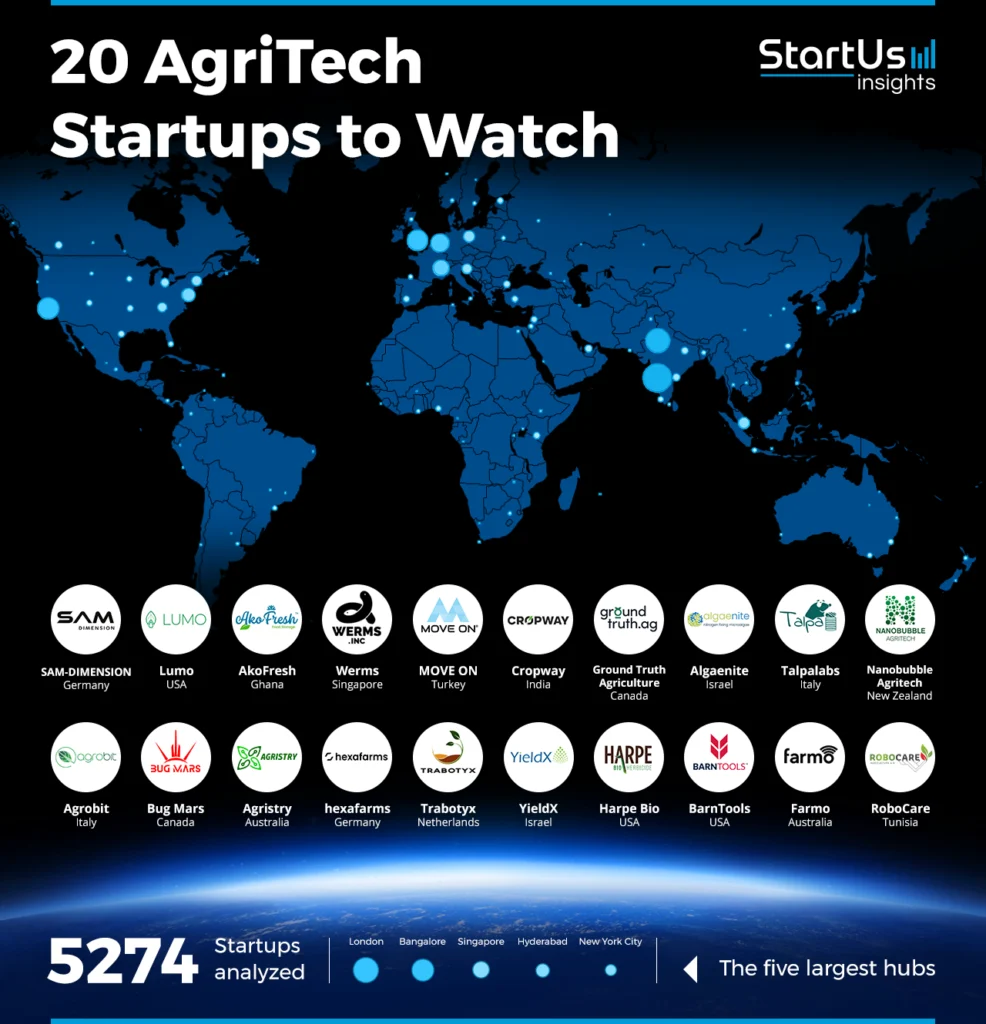
Through the Big Data & Artificial Intelligence (AI)-powered StartUs Insights Discovery Platform, covering over 4.7M+ startups & scaleups globally, we identified 5274 AgriTech startups. The Global Startup Heat Map below highlights the 20 AgriTech startups you should watch in 2025 as well as the geo-distribution of all AgriTech startups & scaleups we analyzed for this research.

AgriTech-Startups-to-Watch-Heat-Map-StartUs-Insights-noresize

Want to explore all 5200+ AgriTech startups & scaleups?
Request Sample Database

Based on the heat map, we see high startup activity in India and Western Europe, followed by the USA. These AgriTech startups work on solutions ranging from agricultural photogrammetry and barn monitoring to early-stage plant disease detection and sustainable weed management.
As the world’s largest resource for data on emerging companies, the SaaS platform enables you to identify relevant technologies and industry trends quickly & exhaustively. Based on the data from the platform, the Top 5 AgriTech Startup Hubs are in London, Bangalore, Singapore, Hyderabad & New York City.
The 20 hand-picked startups highlighted in this report are chosen from all over the world and develop solutions for early-stage plant disease detection, poultry biosecurity, crop mapping, and more.
agritech_startups to watch_agrobit
Agrobit is an Italian startup that makes a decision support system, iAgro. This mobile app uses agricultural photogrammetry to allow farmers to digitally scan and model portions of their crops using a smartphone. By taking photos of their fields or trees and uploading them to the cloud, farmers view 3D models of the scanned areas. The app then provides height, thickness, canopy volume, leaf area index, leaf wall area, and tree row volume metrics.
Farmers create precision agriculture maps by sampling multiple scattered points within a field. These maps show vegetative vigor and variability, helping farmers optimize inputs and focus resources. Repeated scans build a history of each field to compare crop evolution between seasons. Farmers are thus able to generate prescription maps to variably treat crops based on need in different phenological stages and field areas.
agritech_startups to watch_yieldx
Israeli startup YieldX offers biosecurity solutions that use sensors, machine learning, and IoT to provide real-time biosecurity insights for poultry farms. The startup’s technology leverages vision, sound, and smell to monitor farm environments continuously with no human intervention. YieldX develops RedMiteSense, a smart sensor that uses AI to enable continuous monitoring and early detection of red mites in layer poultry farming.
Its other product, BioCore, positioned in fixed locations, monitors ambient conditions and live inventory movements. Whereas, TrolleyMateTag is attached to an egg/chick trolley or transport and monitors eggs and chicks in motion. The startup’s AI-based platform analyzes the data collected from these devices and alerts the farm owners about potential threats. So, by detecting disease outbreaks and pest infestations early on, YieldX enables farmers to proactively address poultry farming issues and maximize yield.
agritech_startups to watch_bug mars
Canadian startup BugMars optimizes insect farm management through artificial intelligence (AI). Its platform, Hexapod, offers 24-hour surveillance using cameras and sensors, eliminating manual checks for pests, food/water reserves, mold, temperature, humidity, and hatching. Hexapod captures images and instantaneously reviews them, continuously tracking temperature, pests, and insect count.
Over time, the system predicts potential issues, recommends actions and refines its accuracy and predictions with the increased data flow. A dashboard provides automated alerts directly to devices and allows customization based on individual needs. Thus, through detailed sensor data and continuous alerts, the platform expands productivity, reduces insect mortality, and streamlines farming processes in general.
agritech_startups to watch_agristry
Australian startup Agristry makes a precision agriculture platform that enables crop mapping through drone imagery analysis and plant indices. The software creates crop health maps and monitors field development over the season. It identifies patterns to generate diagnostic maps that are downloadable as shapefiles for machinery. The startup uses computer vision, AI, and spatial tech to provide valuable insights on plant count, harvest readiness of crops, stress detection, and more.
Agristry also creates weed maps that accurately display the location of infested areas so that farmers are able to tackle weeds before they pose a serious threat. Additionally, the startup offers 3D land survey models to analyze the terrain. Farmers gain valuable insights for land use and development which they are able to leverage for designing efficient field management strategies.
agritech_startups to watch_robocare
RoboCare is a startup from Tunisia that advances early disease detection in greenhouses using hyperspectral imaging and AI. Its solutions, Crop-Care and Toma-Care detect stressed plants before pests are visible when infections are still controllable. Hyperspectral cameras capture near-infrared signals that plant signatures use to differentiate healthy versus stressed plants.
RoboCare also analyzes up-to-date drone, plane, and satellite imagery using crop models and AI to map nutrient deficiencies, diseases, pests, and weeds. The startup provides customized recommendations to optimally manage lands and crops. RoboCare’s digital monitoring system thus enables to farmers address plant health issues before significant crop damage.
agritech_startups to watch_harpe bio
Harpe Bio is a USA-based startup that formulates natural herbicides from plant extracts such as menthol, carbon, and other molecules. These natural herbicides act as alternatives to synthetic chemical herbicides which potentially have significant adverse effects on plant health.
However, Harpe Bio’s bioherbicides control weeds that have developed resistance and work alone or with other herbicides. The startup’s herbicides thus help organic farmers who lack effective weed control options while also enabling sustainability and safer food for consumers.
agritech_startups to watch 2025_Trabotyx
Dutch startup Trabotyx develops an advanced weed control system featuring a single-row autonomous weeding robot with a modular wheelbase. This robot delivers precise weeding by targeting both the spaces between and alongside crops, facilitating farmers’ transition to organic farming without the high costs and weather dependence of manual weeding.
Additionally, it reduces labor costs, allowing farmers to concentrate on other essential tasks. Trabotyx also provides continuous performance monitoring and remote support for the robots, minimizing the time users need to check the machine.
agritech_startups to watch_barntools
USA-based startup Barntools provides BarnTalk, a self-connecting barn alarm for swine and poultry producers. BarnTalk Gateway ensures reliable connectivity, automatically connecting without the need for landlines, WiFi, or cell plans. Designed for remote areas, BarnTalk operates with minimal data and has a self-testing feature that alerts if the system becomes unresponsive.
The accompanying app enables users to set sensor thresholds and monitor barn environments in real-time. A suite of wireless sensors measuring temperature and humidity aids in complete monitoring. Users gain insights into their barn’s conditions, receiving timely notifications via call, text messages, or push notifications. It also monitors trends to preemptively address potential issues.
agritech_startups to watch_farmo
Australian startup Farmo provides IoT solutions for farm monitoring leveraging LoRaWAN and NB-IoT technology. Its products include the Water Rat, a tank and trough sensor that offers real-time water level monitoring. Also, its Water Tank Level Monitor allows users to monitor tank levels frequently, ensuring timely water supply management.
Another product, the Electric Fence Sensor, sends alerts when fence voltage drops, ensuring livestock containment. Farmo’s Gate Sensor detects metal drop-latch in the closed position, which eliminates the problems of false alerts caused by wind or animals rubbing on the gate.
agritech_startups to watch_hexafarms
Hexafarms is a German startup that develops hexaBM, an AgriTech platform that allows greenhouses and vertical indoor farms to track their harvests from seedling to harvest. It continually measures bio-physical factors such as CO2 levels, temperature, humidity, pH, etc., that affect plant growth.
The platform uses machine learning to analyze the data collected through sensors to provide insights into plant growth, stomatal activity, and photosynthetic activity. It also infers trends and predictions about plant growth. Thus, hexafarms enables farmers to optimize crop growth conditions and boost yield.

Interested in exploring all 5200+ AgriTech startups & scaleups?
Request Sample Database


German startup SAM-DIMENSION leverages computer vision and data science to simplify agricultural field surveys. The startup’s weed mapping solution utilizes drones to help farmers identify weeds early on. It links the identified weed seedlings to their precise geolocation. Then, the solution utilizes this data to create a digital map for precise herbicide application with a field sprayer. SAM-DIMENSION thus improves weed control and enhances machine efficiency, enabling farmers to optimize crop yields and reduce costs.

US-based startup Lumo provides irrigation automation solutions for growers. For this, the startup develops a wireless, solar-powered, and connected smart irrigation valve. Its built-in sensor provides growers with accurate flow monitoring and control over water usage. The startup also offers intuitive management software that allows growers to schedule irrigation based on volume or duration.
Further, it detects water leaks and stops irrigation automatically to eliminate flooded fields and water wastage. The startup’s cloud-managed system further allows access, monitoring, and updating of irrigation systems remotely. Its features benefit growers in reducing costs and saving water while ensuring maximum crop yield.

AkoFresh is a Ghana-based startup that provides preservation services for smallholder farmers to reduce post-harvest losses. The startup’s solar-powered cold storage preservation technology extends the shelf life of fruits and vegetables up to 21 days. It consists of cold room panels, solar panels, sensors, a compressor, and an air cooler that makes up the smart solar-powered cool box.
This internet of things (IoT)-enabled, mobile off-grid cold storage technology avoids crop spoilage while farmers find buyers or middlemen. AkoFresh’s solution also benefits the environment as it reduces greenhouse gas emissions and conserves environmental resources.

Singaporean startup Werms upcycles local food waste into sustainable livestock feed and organic fertilizer for animals and plants. The startup’s product range includes crickets, mealworms, super worms, dried insects, and fertilizers that are parasite-free and environmentally friendly.
To make them, Werms collects pre-consumer waste from wholesale centers and uses proprietary processes to manufacture high-quality animal feed and organic fertilizers. It also offers just-in-time (JIT) services for farmers to get fresh livestock feed at their convenience. Werms’ solution reduces food waste and helps farmers improve their animal feed quality and soil health.

Turkish startup MOVE ON develops TASAI, an autonomous tractor kit that enhances tractor performance in the field. It analyzes camera images using AI to extract routes in real time. Further, the kit enables remote intervention through the cloud. With TASAI, tractors perform sowing and post-sowing processes autonomously. This results in the prevention of issues such as overlapping and double planting. The kit also ensures optimal seed and fertilizer usage while saving fuel and time.

Indian startup Cropway makes an integrated AgTech platform that offers technology-enabled, sustainability-focused supply chain solutions. It features geospatial crop advisory and farm intelligence tools that use AI-powered algorithms to provide real-time price forecasting and pest or disease detection. Besides, the platform enables fertilizer calculation and crop prediction.
Its seller studio helps farmers connect with buyers, processors, and output agencies to sell their produce. Additionally, its marketplace offers doorstep delivery for agriculture-related inputs, chemicals, and commodities. This enables agribusiness stakeholders to make data-driven decisions, improve productivity, and enhance profitability.

Israeli startup Algaenite produces biofertilizers from the air using nitrogen-fixing cyanobacteria. The startup’s patented solar-powered process utilizes automated photo-bioreactors to produce bio-nitrogen fertilizer onsite. This technology delivers an eco-friendly, sustainable, and cost-effective alternative to the traditional Haber-Bosch fertilizer production means.
Moreover, the organic fertilizer fully dissolves in water and offers a good yield. It is free of pathogens and hormones as well as features a negative carbon footprint. Algaenite thus allows farmers to ensure sustainable food production.

Italian startup Talpalabs provides a meteorological monitoring system. It consists of an agricultural sensor, Mole, and a companion mobile application, Talpa, for monitoring the farm weather conditions. The system offers data on temperature, soil humidity, and more.
The startup’s sensor uses low-power wide area networks (LoRaWAN) connectivity for data transmission, minimizing management costs and maximizing availability. It also measures soil moisture to optimize crop irrigation. Talpa‘s push notifications also alert farmers on weather conditions and irrigation requirements, preventing crop damage and improving crop quality.

New Zealand-based startup Nanobubble Agritech leverages nanobubble technology to develop a smart irrigation system for farmers. The startup retrofits existing irrigation systems with its solution. Then, its pressurized dissolution technique infuses supersaturated levels of oxygen into irrigation water.
This allows water to hold up more oxygen than usual. With this, Nanobubble AgriTech increases plant growth and improves soil structure and health. It also increases moisture retention in soil, maximizing production potential.

Canadian startup Ground Truth Agriculture provides real-time grain quality data for agri supply chains. The startup’s platform combines advanced machine vision tools and lab techniques to conduct grain analysis and provide insights. With real-time analysis, farmers make informed decisions on marketing, soil management, and crop production practices.
This allows them to optimize on-farm value. The platform also improves seed-to-sale traceability, delivers precise location-based insights, and ensures accurate sampling. Consequently, the platform enhances quality management and grain inventory value.
The AgriTech startups showcased in this report are only a small sample of all startups we identified through our data-driven startup scouting approach. Download our free AgriTech Innovation Report for a broad overview of the industry or get in touch for quick & exhaustive research on the latest technologies & emerging solutions that will impact your company in 2025!

source

Discover 20 Innovative AgriTech Startups to Watch (2025) – StartUs Insights Read More »

ERP modernization: Still a make-or-break project for CIOs

ERP modernization: Still a make-or-break project for CIOs

ERP transformation remains a big mandate and undertaking for IT leaders — and not one most relish doing. But done well, a new ERP implementation can unleash untapped business benefits. Here, CIOs share ERP update experiences and advice.

Business people engage in a lively discussion, showcasing collaborative teamwork. Led by a charismatic leader, they brainstorm creative ideas for a software development project.
Credit: Jacob Lund / Shutterstock

When it embarked on an ERP modernization project, the second time proved to be the charm for Allegis Corp., which performed two ERP deployments in seven years.

“Two ERP deployments in seven years is not for the faint of heart,” admits Dave Shannon, CIO of the hardware distribution firm.

Allegis had been using a legacy on-premises ERP system called Eclipse for about 15 years, which Shannon says met the business needs well but had limitations. Integration with other systems was difficult and it required a lot of specialized resources to make changes, such as business processes and validation during order entry and replenishment to branch offices, he says.

Allegis had been using Eclipse for 10 years, when the system was acquired by Epicor, and Allegis began exploring migrating to a cloud-based ERP system.

“Quite frankly, we didn’t have the internal resources to support an on-premise solution,” Shannon says. The company wanted to leverage all the benefits the cloud could bring, get out of the business of managing hardware and software, and not have to deal with all the complexities around security, he says.

In 2017, after exploring other ERP systems, whittling down a list of around 80 vendors, and defining its business requirements, Allegis selected NetSuite — and it didn’t go well.

“We really liked [NetSuite’s] architecture and that it’s in the cloud, and it hit the vast majority of our business requirements,” Shannon notes. “They had capabilities in all the functional areas that were important to us.”

Dave Shannon
Dave Shannon, CIO, Allegis

Allegis

However, the domain expertise Allegis officials felt the ERP should have in the distribution space was lacking, he says. “It got you most of the way there, but not where we needed it to be, so that meant there were a lot of gaps or extensions” that had to be added.

Allegis plugged the gaps by integrating 12 third-party technologies and building custom solutions to give the company the ability to perform tasks such as replenishment and demand planning. But the changes bogged down the system “because there were so many custom scripts and performance was lagging,” and some processes didn’t work properly, Shannon says.

Almost three years later, Allegis cut its losses, began looking around again, and settled on Epicor Prophet 21. “We went live on April Fool’s Day 2024, and it’s been a really good experience,” Shannon says, adding that IT deployed the system within its 12-month timeframe.

The ERP modernization mandate

ERP modernization is both a big undertaking and a big mandate for CIOs — and not one most relish having to do. Yet, with many organizations looking to innovate, deploy AI and automation, move to the cloud, and gain a competitive advantage, getting ERP system updates right can either be a feather in a CIO’s cap or what sinks them if a project doesn’t go well.

“Today’s CIOs inherit highly customized ERPs and struggle to lead change management efforts, especially with systems that [are the] backbone of all the enterprise’s operations,” wrote Isaac Sacolick, founder and president of StarCIO, a digital transformation consultancy, in a recent blog post. “Many CIOs have succeeded in modernizing applications and developing analytics/ML/AI capabilities, but digital transformation and delivering competitive technologies that drive growth remains a challenging goal.”

[ Related: 10 most powerful ERP vendors today ]

In planning for an ERP upgrade, IT leaders should assess what they have, what they need, and where to focus, says Bill Briggs, CTO of Deloitte. “Think surgical vs. brute force, and ground decisions as much on growth and strategy as on tech stack considerations,” he says.

Under the “what you need” column, consider functional and non-functional lenses, Briggs advises. Leaders should address challenges such as tech and business silos and the inability to scale AI pilots due to a lack of data and integration capabilities.

“One of the biggest dangers is in being overly constrained by ‘institutional inertia’ — how things have always been done and how the tools/tech have always worked,” Briggs says. “Anything that can be standardized can be automated, and almost every legacy business process can [and] should be made simpler to the end user. … Use an ERP upgrade as the trojan horse to harness other emerging technologies.”

AI in ERP: A new must-have

One of those emerging technologies is AI, which is “absolutely critical” in an ERP system, says Allegis’ Shannon.

“As a CIO, if you’re not thinking about AI and putting those plans and technologies and solutions in place … you might be too late,” he says. “We’re dependent on it.” Epicor has a product roadmap that Allegis is banking on to enable the company to use Prophet 21 to train tasks. This might include using AI to figure out the current pricing of an item, and whether they have stock available in certain locations.

Noting that “AI requires really clean data, and a lot of it,” Shannon says IT is also working on applying the right security measures so that data isn’t leaking out of the ERP system.

Allegis partnered with a team from Epicor to import the data and deploy the system in a phased approach, going live with core functionality that met its business requirements, “but we didn’t get fancy with it,” Shannon notes. “We wanted to get the solution in and the data across, and ensure acceptance within the organization. We wanted to be able to replenish our inventory and ship orders — and take orders on day one, and we accomplished that.”

[ Related: The best ERP systems: 10 enterprise resource planning tools compared ]

A few months later, with more experience using Prophet 21, IT has been fine-tuning it.

There were no roadblocks, and the migration came in 20% under budget. However, “what hurt us was the implementation cost” of NetSuite, and realizing “we’d never get it back if we moved and would have to spend in theory, a similar amount by moving to Profit 21,” Shannon says, adding that it was a “fairly significant investment.”

Shannon takes responsibility for the “mistake” of selecting NetSuite and says in hindsight, Allegis would have avoided the need for two ERP implementations if leaders had dug deeper during the product demos.

“The demos [vendors] showed us were, ‘Click here and there and here are the results,’ and it appeared to work that way,” he says. “What we should have done was say, ‘Okay, you showed us what can be done; now show us how you did it because some things you showed in the demo … have different scaling,’ and that’s probably there where we fell short.”

Overcoming ERP transformation challenges

Recognizing its on-prem ERP/warehouse management system was no longer meeting its financial needs from a reporting and analytics perspective, healthcare company LeeSar is in the throes of modernizing by migrating to Oracle Fusion.

The internal ERP was purchased before LeeSar’s pharmacy division started expanding, says Russ Neumeier, VP of IS.

“I like the way Oracle is embedding AI into the ERP and SCM Fusion applications, and I like the opportunity for the smaller, quarterly updates to the apps versus the big-bang-every-five-years-upgrades to other systems,” Neumeier explains. “The quarterly updates will allow us to introduce updated features and functionality more quickly and allow us to innovate for and serve our member hospitals in ways we couldn’t before.”

[ Related: 11 tips for selecting and implementing an ERP system ]

The modernization project has full support of LeeSar’s board and will bring capabilities IT had to develop as one-off processes for the prior system, he says. Oracle will also enable LeeSar to run its business from an enterprise platform.

Because core data has resided in LeeSar’s legacy system for more than a decade, “a fair amount of effort was required to ensure we were bringing clean data into the Oracle platform, so it has required an IT and functional team partnership to ensure the data is accurate as it is migrated.”

Russ Neumeier stylized
Russ Neumeier, VP of IS, LeeSar

LeeSar

Neumeier joined the company three years ago and says that while they do not have a formal data governance structure yet, the data integrity team does a good job keeping customer, supplier, and master data clean.

The process has not been all smooth sailing. “The data migration requires a lot of functional involvement and validation — working around month-end and fiscal year-end processes have been a challenge when the functional teams are also working to fill open roles on their teams,” Neumeier says. “With the fine-tuning of the data extracts and data conversion, we have set up a process with our implementation partner to keep daily snapshots of the data to help demonstrate that the updates to the data are in place.”

Another challenge was that the original project leader from LeeSar’s implementation partner had to leave for health reasons, and the next project leader wasn’t a good fit, Neumeier says.

“We both sensed it, didn’t say anything, and tried to make it work, but within a few weeks, I had an entire project team on the LeeSar side expressing concerns about the second project leader,” he says. “I think if our project leader and I had trusted our gut, we could have moved on this more quickly.”

The team learned a lot from Phase 1A, “and we have jokingly said that Phase 1A has paid the ‘stupid tax’ early so that as we get into the complexities of the warehouse, pharmacy, and custom packs, Phase 1B can go more smoothly,” Neumeier says.

Looking back, Neumeier would “have the subject matter experts in the functions be 100% on the implementation; as a midsized company that runs lean, however, it’s a challenge to have people 100% on a project.”

As they embark on Phase 1B, Neumeier says there will be a “no email rule,” and the team will keep all project communications in Microsoft Teams. This will allow everyone to see everything and not be accidentally missed as a CC: on an email chain, he explains.

It’s all about the data

When Michele Stanton joined HGA, a national design, architecture, and engineering firm two years ago as CIO, she “learned very quickly data was the biggest challenge the company was facing.”

There was no data warehouse or common data environment, so employees were sourcing their own data, doing their own extracts, and reformatting and manipulating data to produce dashboards.

[ Related: Generative AI’s killer enterprise app just might be ERP ]

The firm was using Deltek Vision, which Stanton says is “not well-suited for that — it’s a transactional system, not a data analytics system.” She realized HGA needed a data strategy, a data warehouse, and a data analytics leader. She hired Ryan Haunfelder as director of data and analytics, and they formally embarked on an upgrade to Deltek Vantagepoint.

HGA is a longtime Microsoft shop so Stanton and Haunfelder performed the upgrade using Microsoft Fabric while also implementing a data governance structure. This “put some structure around data quality and data security,” she says.

Michele Stanton
Michele Stanton, CIO, HGA

HGA

HGA completed the upgrade but not without some bumps in the road. While Deltek provides the ability to build custom code, if the data changes, “everything has to respect the change,” Haunfelder says.

“So it’s not just a migration for the ERP; it’s a migration for pretty much every custom application our firm had ever built,” and all the custom code had to now reflect the business logic in Vantagepoint. This included 10 to 15 apps and hundreds of pieces of one-off code, so Haunfelder set up a development environment to install the ERP and test everything.

If Stanton and Haunfelder had more time to plan the upgrade, they would have “stripped out all the stuff that doesn’t belong in” the ERP system, she says.

Ryan Haunfelder
Ryan Haunfelder, director of data and analytics, HGA

HGA

“So our goal was to almost create an apples-to-apples capability in the new platform with a better user experience, but not really changing the way people work,” she says. “The upgrade went as well as could be expected, but it’s not like we completed a digital transformation.”

To realize the full benefits of a digital transformation, there has to be data standards and data quality processes, she says. “You would have data governance in place so that you know your ERP data could be feeding deep insights and analytics for your organization.”

Being brand new to the industry when she joined HGA, and with the upgrade work already started, “I wasn’t in a position to say, ‘Hey everyone, just stop; we’re going to rethink this whole thing, which by the way, is going to take two years and then we’ll talk about Vantagepoint,’” Stanton says.

That said, she feels good about the work IT did and that they got the right business stakeholders engaged and are now more data literate.

Tips for getting ERP upgrades right

Allegis’ Shannon says IT leaders need to not only have a solid understanding of business requirements but also understand business users’ jobs.

“It’s really easy to sit back in my chair and say, ‘Okay, go to the order entry screen and fill this out.’ It looks straightforward, but you’re not doing that job, they are,” he says.

IT must also understand the complexities business units face and what will help them be more efficient, especially with respect to satisfying customers’ requirements. “There’s no way to appreciate that,” Shannon says. “The first time around we probably took for granted that we understood what they needed.”

Shannon put together a bigger team for Allegis’ Prophet 21 implementation, assembling “the right people in all the functional areas of the business,” emphasizing that they had an equal voice in this deployment.

“When you empower [people] and give them an equal voice at the table, you end up with a better solution,” Shannon says. “Because they’re involved along the way, onboarding and training become much easier.”

He also advises understanding what a vendor means by “partner.” Sometimes vendors just want to partner on getting a deal done; in other cases, they want to understand your business and work together to make your job easier, Shannon says.

LeeSar’s Neumeier agrees, saying his firm emphasizes collaboration with its implementation partner and Oracle. “We are all after the same thing, which is a wildly successful implementation,” he says. “To do that, eliminate the us-versus-them language and emphasize working assumptions often.”

“Offer grace if a mistake is made and make it right if you missed something,” Neumeier adds.

Further, CIO’s should frame ERP modernization as a business initiative, not an IT project, he says. “Modernizing our ERP/WMS cannot be something that IT alone does for the business, and so we are involving every department in our business in the implementation.”

The team is also injecting a bit of fun into the project, Neumeier adds. “As new members come on … we invite them to add a song to our implementation playlist” that motivates, energizes, or puts a person in a good mood, he says, “because we know we will hit bumps, get frustrated, or feel the stress of a looming deadline.”

When modernizing an ERP system, go into it with your eyes open, says Allegis’ Shannon.

“Probably the most disruptive thing you can do is swap out your ERP system. It touches every aspect of the business, so it’s not something to be taken lightly,” he says. “While you’re going through the process — and sometimes even after — you can start working on the tool and stop working on business.”

source

ERP modernization: Still a make-or-break project for CIOs Read More »

The 7 key components of a digital transformation strategy

The 7 key components of a digital transformation strategy

Why develop a digital transformation strategy?

You may not feel that digital transformation is worth the investment, but it’s a key aspect of any modern business strategy. It offers many benefits that can help you stay competitive, including:

  • Enhanced customer experienceDigital tools streamline the customer service experience using chatbots, data retrieval, and automation tools.
  • Increased operational efficiency: Take advantage of automation tools to remove redundant tasks and improve business processes.
  • Adaptability: Quickly adapt to consumer trends and shift to new business models like e-commerce and subscription services.

Here are the top seven digital transformation strategies recommended by business leaders to help your organization evolve in this digital age.

1. Focus on the digital tools your team wants

  • Project management and tracking toolsProject management tools (like OdooProjects, Trello, Asana, and Monday) and time-tracking tools (like Tick and Timecamp) can help you increase employee efficiency and measure team performance.
  • Social media management tools: Digital marketing tools like OdooCRM, Buffer, and Hootsuite automate your social media marketing efforts and help you manage your social presence more easily.
  • Digital communication tools: Remote and hybrid environments work better with digital communication tools like Zoom and Slack, which offer real-time collaboration abilities for your team and clients.

2. Improve your cybersecurity tools and procedures

As you transform your business to use digital tools, you’ll rely heavily on the internet to get more done. But this also exposes your company to cyber threats like viruses, malware, and phishing.

Having a risk-averse digital transition means putting measures in place to secure your environment and mitigate potential cybercrime. Here are some ways to keep data safe and secure to protect your business.

  • Protect your accounts: Encourage employees to use strong passwords and change them regularly. Use two-factor authentication (2FA) and VPN services for remote employees to encrypt data accessed outside the office.
  • Protect your devices: Schedule regular updates to prevent new security vulnerabilities and use intrusion detection software to monitor network traffic and look for ongoing threats.
  • Maintain your environment: Maintain a secure environment by teaching employees to stay safe online and conduct security audits to test your security systems.

3. Increase your research and development budget

Investing in new tech costs money, which can cause some hesitation. But with how impactful these tools are, funding their research and development (R&D) makes sense and can take your business to a higher level. Here are two more ways to improve your R&D efforts:

  • Trust your R&D team to make the best decisions: Part of R&D involves creating a methodology for making independent decisions. Give them the information they need to define requirements and evaluate tech solutions that will work, then trust them to do it right.
  • Keep everyone involved in the R&D process: Keep all team members up to date with R&D initiatives and progress. This fosters transparency, keeps everyone aligned with company goals, promotes collaboration and innovation in the decision-making process, and lets teams collectively identify and address any challenges or roadblocks.

4. Hiring and growing competitive talent

As two-thirds of companies plan to invest more in digital technology and software in 2023, competition for digitally savvy talent will grow as well. And when you need the best minds to succeed with digital transformations, you need experts in relevant fields like data science, artificial intelligence, and IT.

Finding the right talent for the transformation process means creating an appealing environment for tech professionals and providing the resources needed to make effective changes. These might include offering flexible remote or hybrid work arrangements and periodic professional development opportunities. Other helpful tips are to:

  • Show your value proposition to prospective talent: prove your company is worth working for by offering a fair salary, good benefits, leadership roles, career development, and commitment to digital modernization. Be sure to include these details in any job postings or other communications about open positions in order to attract the best talent to your organization.
  • Promote from within: Look within your company for experienced people willing to reskill and upskill to learn new tools and promote digital business transformation. This increases employee loyalty, motivation, and engagement, as existing employees see opportunities for career growth and development within the organization.

5. Developing user-friendly digital systems

The right technology should support users and simplify everyday business workflows – but that won’t happen if your systems aren’t user-friendly. They need to work well and integrate seamlessly into your business. Here are some key best practices:

  • Test before you buy: Use free trials to test products before buying to ensure functionality and confirm they meet all your company’s requirements. This allows you to explore their features, assess their usability, and validate their compatibility with your existing systems or workflows.
  • Get team feedback: Let your team evaluate new products, share their insights, and provide feedback so you can gauge user experience quality and product effectiveness from different perspectives. This not only enhances team engagement and satisfaction, but also allows you to leverage diverse expertise and experiences.

6. Using data analytics to inform decision making

Cloud computing and data analytics let you extract patterns and trends from big data. New machine learning AI applications can read large amounts of data, analyze it to find patterns and trends, and extract information your business can use to meet your key performance indicators (KPIs) and drive revenue growth. Here are some of the best ways to do it:

  • Use analytics to gather data: Gathering and analyzing data metrics help you see what’s working and what’s not so you can make better business decisions. Leverage advanced analytics techniques, such as machine learning and AI, to extract valuable insights and optimize marketing strategies that can help you meet your key performance indicators (KPIs) and drive business growth.
  • Forecast future sales and trends: Use data to forecast future trends, enabling you to make informed business decisions and proactively respond to market changes. For example, you can use historical data to predict future sales volumes for effective supply chain optimization, identify emerging product trends and new opportunities, and gain a competitive advantage.

7. Convince team members and stakeholders to help

You may need to convince stakeholders and team members to embrace digital technologies and integrate digital transformation initiatives into your company’s culture and policies.

Although you might initially face resistance to this culture change, it can help to gradually encourage buy-in. Convince people that adopting these new tools will make their jobs easier and make your business more efficient and resistant to future market shifts.

  • Finding the rights partners: The right partnerships can help you make your case. Working with technology companies that have extensive product ecosystems can help you demonstrate the business value of investing in their new technology. Choose partners that offer the proper training and user support to help your team feel comfortable adopting their tools..
  • Use tried-and-true change management techniques: Preparing employees and other stakeholders for organizational change means more than just letting them know your digital transformation plans. Proper change management involves planning and preparation before implementing a change, followed by monitoring and evaluating progress and results.

How to grow your business with digital transformation?

Digital business technology plays a huge role in business today, and ignoring its many benefits can leave you behind your competitors. Don’t wait to create a digital transformation roadmap for your organization.

Let us show you how to lead your organization through uncharted territory. Our programs are designed to help you embrace digital disruption as an opportunity so you can transform your business to adapt to today’s globally connected virtual world. Explore our digital transformation programs and see what successful digital transformation can do for your organization.

source

The 7 key components of a digital transformation strategy Read More »

AI, automation, and the future of work: Ten things to solve for – McKinsey

Automation and artificial intelligence (AI) are transforming businesses and will contribute to economic growth via contributions to productivity. They will also help address “moonshot” societal challenges in areas from health to climate change.

At the same time, these technologies will transform the nature of work and the workplace itself. Machines will be able to carry out more of the tasks done by humans, complement the work that humans do, and even perform some tasks that go beyond what humans can do. As a result, some occupations will decline, others will grow, and many more will change.

While we believe there will be enough work to go around (barring extreme scenarios), society will need to grapple with significant workforce transitions and dislocation. Workers will need to acquire new skills and adapt to the increasingly capable machines alongside them in the workplace. They may have to move from declining occupations to growing and, in some cases, new occupations.

This executive briefing, which draws on the latest research from the McKinsey Global Institute, examines both the promise and the challenge of automation and AI in the workplace and outlines some of the critical issues that policy makers, companies, and individuals will need to solve for.

  1. Accelerating progress in AI and automation is creating opportunities for businesses, the economy, and society
  2. How AI and automation will affect work
  3. Key workforce transitions and challenges
  4. Ten things to solve for

Accelerating progress in AI and automation is creating opportunities for businesses, the economy, and society

Automation and AI are not new, but recent technological progress is pushing the frontier of what machines can do. Our research suggests that society needs these improvements to provide value for businesses, contribute to economic growth, and make once unimaginable progress on some of our most difficult societal challenges. In summary:

Rapid technological progress

Beyond traditional industrial automation and advanced robots, new generations of more capable autonomous systems are appearing in environments ranging from autonomous vehicles on roads to automated check-outs in grocery stores. Much of this progress has been driven by improvements in systems and components, including mechanics, sensors and software. AI has made especially large strides in recent years, as machine-learning algorithms have become more sophisticated and made use of huge increases in computing power and of the exponential growth in data available to train them. Spectacular breakthroughs are making headlines, many involving beyond-human capabilities in computer vision, natural language processing, and complex games such as Go.

Potential to transform businesses and contribute to economic growth

These technologies are already generating value in various products and services, and companies across sectors use them in an array of processes to personalize product recommendations, find anomalies in production, identify fraudulent transactions, and more. The latest generation of AI advances, including techniques that address classification, estimation, and clustering problems, promises significantly more value still. An analysis we conducted of several hundred AI use cases found that the most advanced deep learning techniques deploying artificial neural networks could account for as much as $3.5 trillion to $5.8 trillion in annual value, or 40 percent of the value created by all analytics techniques (Exhibit 1).

Exhibit 1AI has the potential to create value across sectors
We strive to provide individuals with disabilities equal access to our website. If you would like information about this content we will be happy to work with you. Please email us at: McKinsey_Website_Accessibility@mckinsey.com

Deployment of AI and automation technologies can do much to lift the global economy and increase global prosperity, at a time when aging and falling birth rates are acting as a drag on growth. Labor productivity growth, a key driver of economic growth, has slowed in many economies, dropping to an average of 0.5 percent in 2010–2014 from 2.4 percent a decade earlier in the United States and major European economies, in the aftermath of the 2008 financial crisis after a previous productivity boom had waned. AI and automation have the potential to reverse that decline: productivity growth could potentially reach 2 percent annually over the next decade, with 60 percent of this increase from digital opportunities.

Potential to help tackle several societal moonshot challenges

AI is also being used in areas ranging from material science to medical research and climate science. Application of the technologies in these and other disciplines could help tackle societal moonshot challenges. For example, researchers at Geisinger have developed an algorithm that could reduce diagnostic times for intracranial hemorrhaging by up to 96 percent. Researchers at George Washington University, meanwhile, are using machine learning to more accurately weight the climate models used by the Intergovernmental Panel on Climate Change.

Challenges remain before these technologies can live up to their potential for the good of the economy and society everywhere

AI and automation still face challenges. The limitations are partly technical, such as the need for massive training data and difficulties “generalizing” algorithms across use cases. Recent innovations are just starting to address these issues. Other challenges are in the use of AI techniques. For example, explaining decisions made by machine learning algorithms is technically challenging, which particularly matters for use cases involving financial lending or legal applications. Potential bias in the training data and algorithms, as well as data privacy, malicious use, and security are all issues that must be addressed. Europe is leading with the new General Data Protection Regulation, which codifies more rights for users over data collection and usage.

A different sort of challenge concerns the ability of organizations to adopt these technologies, where people, data availability, technology, and process readiness often make it difficult. Adoption is already uneven across sectors and countries. The finance, automotive, and telecommunications sectors lead AI adoption. Among countries, US investment in AI ranked first at $15 billion to $23 billion in 2016, followed by Asia’s investments of $8 billion to $12 billion, with Europe lagging behind at $3 billion to $4 billion.Section 2

How AI and automation will affect work

Even as AI and automation bring benefits to business and society, we will need to prepare for major disruptions to work.

About half of the activities (not jobs) carried out by workers could be automated

Our analysis of more than 2000 work activities across more than 800 occupations shows that certain categories of activities are more easily automatable than others. They include physical activities in highly predictable and structured environments, as well as data collection and data processing. These account for roughly half of the activities that people do across all sectors. The least susceptible categories include managing others, providing expertise, and interfacing with stakeholders.

Nearly all occupations will be affected by automation, but only about 5 percent of occupations could be fully automated by currently demonstrated technologies. Many more occupations have portions of their constituent activities that are automatable: we find that about 30 percent of the activities in 60 percent of all occupations could be automated. This means that most workers—from welders to mortgage brokers to CEOs—will work alongside rapidly evolving machines. The nature of these occupations will likely change as a result.

Would you like to learn more about the McKinsey Global Institute?

Jobs lost: Some occupations will see significant declines by 2030

Automation will displace some workers. We have found that around 15 percent of the global workforce, or about 400 million workers, could be displaced by automation in the period 2016–2030. This reflects our midpoint scenario in projecting the pace and scope of adoption. Under the fastest scenario we have modeled, that figure rises to 30 percent, or 800 million workers. In our slowest adoption scenario, only about 10 million people would be displaced, close to zero percent of the global workforce (Exhibit 2).

Exhibit 2
We strive to provide individuals with disabilities equal access to our website. If you would like information about this content we will be happy to work with you. Please email us at: McKinsey_Website_Accessibility@mckinsey.com

The wide range underscores the multiple factors that will impact the pace and scope of AI and automation adoption. Technical feasibility of automation is only the first influencing factor. Other factors include the cost of deployment; labor-market dynamics, including labor-supply quantity, quality, and the associated wages; the benefits beyond labor substitution that contribute to business cases for adoption; and, finally, social norms and acceptance. Adoption will continue to vary significantly across countries and sectors because of differences in the above factors, especially labor-market dynamics: in advanced economies with relatively high wage levels, such as France, Japan, and the United States, automation could displace 20 to 25 percent of the workforce by 2030, in a midpoint adoption scenario, more than double the rate in India.

Jobs gained: In the same period, jobs will also be created

Even as workers are displaced, there will be growth in demand for work and consequently jobs. We developed scenarios for labor demand to 2030 from several catalysts of demand for work, including rising incomes, increased spending on healthcare, and continuing or stepped-up investment in infrastructure, energy, and technology development and deployment. These scenarios showed a range of additional labor demand of between 21 percent to 33 percent of the global workforce (555 million and 890 million jobs) to 2030, more than offsetting the numbers of jobs lost. Some of the largest gains will be in emerging economies such as India, where the working-age population is already growing rapidly.

Additional economic growth, including from business dynamism and rising productivity growth, will also continue to create jobs. Many other new occupations that we cannot currently imagine will also emerge and may account for as much as 10 percent of jobs created by 2030, if history is a guide. Moreover, technology itself has historically been a net job creator. For example, the introduction of the personal computer in the 1970s and 1980s created millions of jobs not just for semiconductor makers, but also for software and app developers of all types, customer-service representatives, and information analysts.

Jobs changed: More jobs than those lost or gained will be changed as machines complement human labor in the workplace

Partial automation will become more prevalent as machines complement human labor. For example, AI algorithms that can read diagnostic scans with a high degree of accuracy will help doctors diagnose patient cases and identify suitable treatment. In other fields, jobs with repetitive tasks could shift toward a model of managing and troubleshooting automated systems. At retailer Amazon, employees who previously lifted and stacked objects are becoming robot operators, monitoring the automated arms and resolving issues such as an interruption in the flow of objects.

Section 3

Key workforce transitions and challenges

While we expect there will be enough work to ensure full employment in 2030 based on most of our scenarios, the transitions that will accompany automation and AI adoption will be significant. The mix of occupations will change, as will skill and educational requirements. Work will need to be redesigned to ensure that humans work alongside machines most effectively.

Workers will need different skills to thrive in the workplace of the future

Automation will accelerate the shift in required workforce skills we have seen over the past 15 years. Demand for advanced technological skills such as programming will grow rapidly. Social, emotional, and higher cognitive skills, such as creativity, critical thinking, and complex information processing, will also see growing demand. Basic digital skills demand has been increasing and that trend will continue and accelerate. Demand for physical and manual skills will decline but will remain the single largest category of workforce skills in 2030 in many countries (Exhibit 3). This will put additional pressure on the already existing workforce-skills challenge, as well as the need for new credentialing systems. While some innovative solutions are emerging, solutions that can match the scale of the challenge will be needed.

Automation and artificial intelligence will accelerate the shift in skills that the workforce needs.
We strive to provide individuals with disabilities equal access to our website. If you would like information about this content we will be happy to work with you. Please email us at: McKinsey_Website_Accessibility@mckinsey.com

Many workers will likely need to change occupations

Our research suggests that, in a midpoint scenario, around 3 percent of the global workforce will need to change occupational categories by 2030, though scenarios range from about 0 to 14 percent. Some of these shifts will happen within companies and sectors, but many will occur across sectors and even geographies. Occupations made up of physical activities in highly structured environments or in data processing or collection will see declines. Growing occupations will include those with difficult to automate activities such as managers, and those in unpredictable physical environments such as plumbers. Other occupations that will see increasing demand for work include teachers, nursing aides, and tech and other professionals.

Workplaces and workflows will change as more people work alongside machines

As intelligent machines and software are integrated more deeply into the workplace, workflows and workspaces will continue to evolve to enable humans and machines to work together. As self-checkout machines are introduced in stores, for example, cashiers can become checkout assistance helpers, who can help answer questions or troubleshoot the machines. More system-level solutions will prompt rethinking of the entire workflow and workspace. Warehouse design may change significantly as some portions are designed to accommodate primarily robots and others to facilitate safe human-machine interaction.

Automation will likely put pressure on average wages in advanced economies

The occupational mix shifts will likely put pressure on wages. Many of the current middle-wage jobs in advanced economies are dominated by highly automatable activities, such as in manufacturing or in accounting, which are likely to decline. High-wage jobs will grow significantly, especially for high-skill medical and tech or other professionals, but a large portion of jobs expected to be created, including teachers and nursing aides, typically have lower wage structures. The risk is that automation could exacerbate wage polarization, income inequality, and the lack of income advancement that has characterized the past decade across advanced economies, stoking social, and political tensions.

In the face of these looming challenges, workforce challenges already exist

Most countries already face the challenge of adequately educating and training their workforces to meet the current requirements of employers. Across the OECD, spending on worker education and training has been declining over the last two decades. Spending on worker transition and dislocation assistance has also continued to shrink as a percentage of GDP. One lesson of the past decade is that while globalization may have benefited economic growth and people as consumers, the wage and dislocation effects on workers were not adequately addressed. Most analyses, including our own, suggest that the scale of these issues is likely to grow in the coming decades. We have also seen in the past that large-scale workforce transitions can have a lasting effect on wages; during the 19th century Industrial Revolution, wages in the United Kingdom remained stagnant for about half a century despite rising productivity—a phenomenon known as “Engels’ Pause,” (PDF–690KB) after the German philosopher who identified it.

Ten things to solve for

In the search for appropriate measures and policies to address these challenges, we should not seek to roll back or slow diffusion of the technologies. Companies and governments should harness automation and AI to benefit from the enhanced performance and productivity contributions as well as the societal benefits. These technologies will create the economic surpluses that will help societies manage workforce transitions. Rather, the focus should be on ways to ensure that the workforce transitions are as smooth as possible. This is likely to require actionable and scalable solutions in several key areas:

  • Ensuring robust economic and productivity growth. Strong growth is not the magic answer for all the challenges posed by automation, but it is a prerequisite for job growth and increasing prosperity. Productivity growth is a key contributor to economic growth. Therefore, unlocking investment and demand, as well as embracing automation for its productivity contributions, is critical.
  • Fostering business dynamism. Entrepreneurship and more rapid new business formation will not only boost productivity, but also drive job creation. A vibrant environment for small businesses as well as a competitive environment for large business fosters business dynamism and, with it, job growth. Accelerating the rate of new business formation and the growth and competitiveness of businesses, large and small, will require simpler and evolved regulations, tax and other incentives.
  • Evolving education systems and learning for a changed workplace. Policy makers working with education providers (traditional and nontraditional) and employers themselves could do more to improve basic STEM skills through the school systems and improved on-the-job training. A new emphasis is needed on creativity, critical and systems thinking, and adaptive and life-long learning. There will need to be solutions at scale.
  • Investing in human capital. Reversing the trend of low, and in some countries, declining public investment in worker training is critical. Through tax benefits and other incentives, policy makers can encourage companies to invest in human capital, including job creation, learning and capability building, and wage growth, similar to incentives for private sector to invest in other types of capital including R&D.
  • Improving labor-market dynamism. Information signals that enable matching of workers to work, credentialing, could all work better in most economies. Digital platforms can also help match people with jobs and restore vibrancy to the labor market. When more people change jobs, even within a company, evidence suggests that wages rise. As more varieties of work and income-earning opportunities emerge including the gig economy, we will need to solve for issues such as portability of benefits, worker classification, and wage variability.
  • Redesigning work. Workflow design and workspace design will need to adapt to a new era in which people work more closely with machines. This is both an opportunity and a challenge, in terms of creating a safe and productive environment. Organizations are changing too, as work becomes more collaborative and companies seek to become increasingly agile and nonhierarchical.
  • Rethinking incomes. If automation (full or partial) does result in a significant reduction in employment and/or greater pressure on wages, some ideas such as conditional transfers, support for mobility, universal basic income, and adapted social safety nets could be considered and tested. The key will be to find solutions that are economically viable and incorporate the multiple roles that work plays for workers, including providing not only income, but also meaning, purpose, and dignity.
  • Rethinking transition support and safety nets for workers affected. As work evolves at higher rates of change between sectors, locations, activities, and skill requirements, many workers will need assistance adjusting. Many best practice approaches to transition safety nets are available, and should be adopted and adapted, while new approaches should be considered and tested.
  • Investing in drivers of demand for work. Governments will need to consider stepping up investments that are beneficial in their own right and will also contribute to demand for work (for example, infrastructure, climate-change adaptation). These types of jobs, from construction to rewiring buildings and installing solar panels, are often middle-wage jobs, those most affected by automation.
  • Embracing AI and automation safely. Even as we capture the productivity benefits of these rapidly evolving technologies, we need to actively guard against the risks and mitigate any dangers. The use of data must always take into account concerns including data security, privacy, malicious use, and potential issues of bias, issues that policy makers, tech and other firms, and individuals will need to find effective ways to address.

There is work for everyone today and there will be work for everyone tomorrow, even in a future with automation. Yet that work will be different, requiring new skills, and a far greater adaptability of the workforce than we have seen. Training and retraining both midcareer workers and new generations for the coming challenges will be an imperative. Government, private-sector leaders, and innovators all need to work together to better coordinate public and private initiatives, including creating the right incentives to invest more in human capital. The future with automation and AI will be challenging, but a much richer one if we harness the technologies with aplomb—and mitigate the negative effects.

source

AI, automation, and the future of work: Ten things to solve for – McKinsey Read More »

10 Best ERP Systems Put To the Test

I’ve worked with various teams—sales, marketing, finance, and project management—and I’ve seen firsthand how enterprise resource planning (ERP) systems can be both incredibly helpful and a source of endless headaches.

I love how best ERP systems promise streamlined operations, better insights, and a unified view of the business. But sometimes it doesn’t take long before you’re asking, why is this so complicated? Or why can’t it just do what we need it to do?

I’ve been through it all: trying to adapt an ERP system to fit business processes it wasn’t designed for, seeing teams learn systems that feel anything but user-friendly, and even the discovery of hidden costs after the implementation is already underway.

I know these challenges quickly compound when you try to ‘get it right’ during ERP software selection process. You’ll probably agree with me that a wrong choice disrupts workflows, demoralizes employees, and wastes precious resources.

What do we think about the future of ERP systems?

“Despite its challenges, ERP remains an essential part of the tech stack of companies with complex operations, regardless of their size and industry. This is due to the fact that ERP provides an integrated system that streamlines operations across the organization and provides functionality for multiple departments, from accounting to logistics and manufacturing, oftentimes including sales and human resources.

Some challenges still remain, such as integration and flexibility, as well as the cost of implementation, maintenance, and support. It is safe to say that ERP is here to stay and will keep its critical role in helping companies improve productivity and profitability.”

– Gabriel Gheorghiu, Research Principal, G2

Whether you’re upgrading from an outdated solution or exploring ERP systems for the first time, I want to help you identify red flags and choose a system that aligns with your needs. That’s why I teamed up with Gabriel Gheorghiu, our resident ERP expert, and worked with folks from all kinds of teams that rely on ERPs to help you find the best ERP systems out there.

10 best ERP systems for 2025: My recommendations

An ERP system brings all your core business departments like finance, HR, supply chain, and sales into one place to make things run smoother, keep data accurate, and help you make better decisions.

How did we find and evaluate the best ERP software?

I spent weeks teaming up with our in-house ERP experts and teams that actually use it—sales, marketing, finance, and project management—to figure out what ERP systems do well, where they struggle, and if they’re worth your time. I also used AI to analyze product reviews on G2, digging into real users’ needs, motivations, and pain points. On top of that, I checked out G2’s Grid Reports to see how these ERP software compare. All that research led to this list of the best ERP systems, made just for you.

After exploring ERP systems, I found that the best ones integrate key business processes like finance, HR, and supply chain into one platform. They offer real-time data for smarter decision-making, are scalable to grow with your business, and have user-friendly interfaces with strong customer support, making them essential for streamlining operations and improving efficiency.

My take on what sets best ERP systems apart

When I started evaluate ERP systems, I focus on a few critical factors to ensure the system is a perfect fit for the business. Here’s what I look for:

  • Fits business needs: I started by ensuring the ERP system matches specific business processes and requirements that most users want. It has to handle all the essentials, like finance, HR, supply chain, and project management, while also addressing any industry-specific needs. For me, if it doesn’t support the way the business works today and where it’s headed, it’s not the right choice.
  • Scalability: I also evaluated whether the ERP software can grow with the business. A great ERP system should handle increased workloads, support additional users, and adapt to business or process changes without causing major disruptions.
  • Integrations: An ERP system also has to work seamlessly with existing tools, whether it’s CRM softwaree-commerce platforms, or other specialized applications. If it doesn’t integrate well, it creates more problems than it solves. I tested how easily the ERP communicates with other systems to ensure smooth data flow across the organization.
  • Ease of use: If the ERP system isn’t intuitive, it can lead to frustration and low adoption rates among your team members. That’s why I paid close attention to the training and resources the vendor provides. For me, a good ERP goes beyond offering great features. It makes it easy for people to actually use those features.
  • Total cost of ownership (TCO): I also looked into the costs, not just the upfront price tag. This includes implementation, licensing, customization, training, ongoing maintenance, and upgrades. Understanding the long-term financial commitment helps avoid unpleasant surprises down the line. I always recommend comparing the TCO against the value the ERP solution brings to the table.
  • Vendor reputation: Lastly, I considered the vendor’s track record. I read reviews, checked out their customer base, and even talked to current users when I could. Knowing I can count on the vendor for help with implementation, troubleshooting, and updates gives me peace of mind.

By focusing on these factors, you can confidently choose an ERP system that meets current needs and sets you up for long-term success. Over the past few weeks, I tested over 20 ERP software solutions. The top 10 that made the list stood out for their ability to meet business needs, ease of integration, user-friendly design, and overall cost-effectiveness.

To be included in the ERP software category, a product must:

  • General ledger, accounts payable/receivable, budgeting, and cash management features
  • Human resources functionality like recruiting and payroll, or integration with HR and payroll solutions
  • Basic sales and customer management features or integration with CRM solutions
  • Functions to create quotes, sales orders, and returns
  • Purchasing workflows and purchase order management
  • Work with inventory and warehouse management software for picking, packing, and shipping
  • Offer advanced supply chain modules, including demand planning and transportation management for distribution companies
  • Provide production modules like bill of materials (BOM), manufacturing resource planning (MRP), and quality management features for manufacturing companies
  • Feature reporting and analytics for all the modules included in the ERP solution

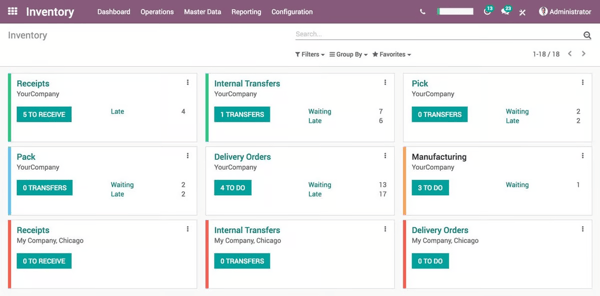
1. Odoo ERP

Using Odoo ERP made us feel like having a fully customizable and versatile system at our fingertips.

From a technical perspective, Odoo’s open-source nature is a huge advantage. It allowed us to customize workflows, dashboards, and even the core functionality to meet our specific needs. The system is built on Python, and while we needed skilled developers to fine-tune some features, the customization options were nearly limitless. We run Odoo on a Linux-based environment, which we’ve found to be the most stable and efficient setup. While it can operate on Windows, Linux gave us better performance and community support, which is a significant bonus.

Odoo ERP
To get the best performance, we’ve had to ensure our hardware meets Odoo’s requirements. For smaller deployments with up to 10 users, a dual-core CPU, 2 GB of RAM, and 10 GB of storage are sufficient. However, as our operations expanded, we scaled up to a quad-core CPU, 16 GB of RAM, and 50 GB of storage to handle larger datasets and more users.

We felt that implementing the system was a complex process that required planning and technical expertise, especially when integrating third-party applications or customizing the source code. Its extensive functionality meant we had to invest time in training our team to use it effectively. Additionally, while the interface is user-friendly, we’ve occasionally experienced slowdowns when handling large data volumes, which can be frustrating.

Customer support has been hit or miss for us. While there’s plenty of community-driven help available, official support can sometimes be inconsistent, which made resolving critical issues a bit challenging.

What I like about Odoo ERP:

  • I love how we can tailor Odoo ERP to fit our business needs, whether it’s adjusting workflows or adding modules as we grow. Its open-source nature gives us the freedom to make it truly our own.
  • The modular pricing structure is a huge plus for us. We only paid for the features we used, making it a budget-friendly option for managing our operations.

What  G2 users like about Odoo ERP:

“Odoo is simple and full of features including APIs that helped us integrate the company functions to implement great features to become more responsive to our customers and automated practically every aspect of our business. The support and follow up that we have from the team in our local language was super. Now Odoo practically runs the company.”

– Odoo ERP review, Maan B.

What I dislike about Odoo ERP:
  • It required us technical expertise and a lot of planning, especially when integrating third-party applications or customizing features.
  • While the community is helpful, I’ve found the official support to be hit or miss, which can be frustrating when I run into critical issues.
What G2 users dislike about Odoo ERP:

“Although Odoo ERP is highly customizable, the process can be complex and requires a good understanding of both the platform and its underlying code. For businesses without in-house technical expertise, this can lead to reliance on external developers, which may increase costs and time for implementation.”

– Odoo ERP Review, Khurshid A.

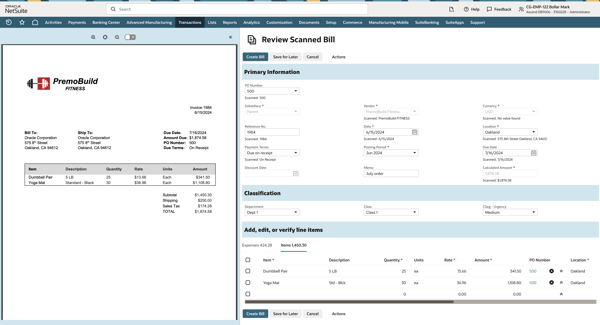
2. NetSuite

When I worked with NetSuite, I found it to be technically robust, cloud-based ERP solution that brings all core business functions like finance, CRM, inventory, and e-commerce onto a single, unified platform.

What I found impressive was its real-time visibility into financial and operational data, which makes decision-making more informed and strategic. Its flexibility is amazing too, with a high level of customization for workflows, reports, and dashboards, so I can tailor it to fit specific business needs perfectly. Plus, its scalable architecture handles growing transaction volumes and user bases without skipping a beat, making it ideal for businesses preparing to expand.

NetSuite ERP

NetSuite also excels with its integration capabilities. Its application programming interfaces (APIs) make connecting with third-party applications straightforward, ensuring smooth data flow across systems. I also appreciated its automation tools, which reduce manual work and boost efficiency across departments.

I’ve also found some challenges. Implementing NetSuite can be a complex process, requiring time, expertise, and thorough training for teams to fully adopt it. The pricing is something I always kept in mind, as the subscription fees, add-on modules, and ongoing maintenance can add up quickly, especially for smaller businesses. I noticed occasional performance issues, like system sluggishness or downtime, which can be frustrating during busy periods.

Customer support is another area where I’ve seen room for improvement. While it’s available, resolving more technical issues often takes longer than I’d like, so I made sure to have either internal expertise or reliable external consultants on hand.

What I like about NetSuite:

  • I love how NetSuite brings all key business functions together in one platform.
  • I appreciate how NetSuite lets me customize workflows and reports to suit my needs, and it integrates smoothly with other tools our team uses.

What G2 users like about NetSuite:

“Having everything in one spot makes my day so much easier. I can pull financial reports while also checking on how customer relationship management (CRM) leads are doing for sales. It’s pretty easy to integrate with other systems if your existing NetSuite environment is well set up and well understood. I feel like I can set up my reports pretty intuitively and that my opportunities for customization are almost endless, with some obvious caveats.”

– NetSuite Review, Lilly W.

What I dislike about NetSuite:
  • I found the implementation process to be challenging and expensive, especially with the additional costs for advanced modules and maintenance.
  • I’ve experienced occasional system slowdowns, and the customer support can sometimes be less responsive than I’d like.
What G2 users dislike about NetSuite:

“The implementation process was inadequate. There wasn’t sufficient analysis of the existing workflows by the NetSuite subject matter experts to determine (a) how NetSuite could accommodate existing workflows or (b) if existing workflows needed to change to accommodate NetSuite processes or perhaps leverage NetSuite features and functions. Similarly, the training was lacking. It was more a demonstration of default NetSuite features rather than training on the product as installed and configured in our environment. While additional training and support is available for a fee, the basic implementation and training need to be strengthened to support a successful initial adoption.”

– NetSuite Review, Richard K.

Need program management tips? Check out program management templates, best practices, and tools you should try.

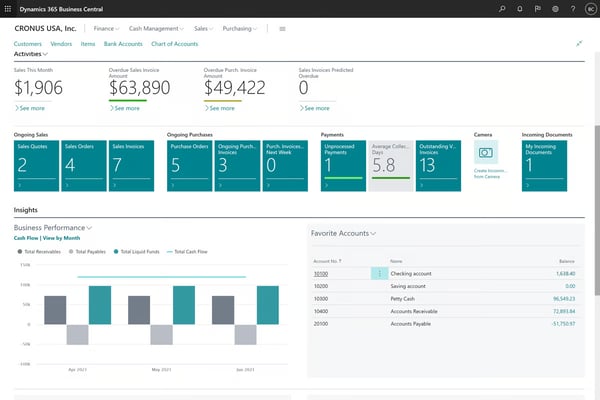
3. Microsoft Dynamics 365 Business Central

When using Microsoft Dynamics 365 Business Central, I found it to be a robust, cloud-based ERP solution that integrates essential business functions like finance, sales, inventory, and customer service.

What stood out to me is how seamlessly it connected with other Microsoft products, like Office 365 and Outlook. I was also impressed by its financial management tools which provided our team real-time insights into accounting, budgeting, and financial performance.

microsoft dynamics 365

I also liked the flexibility of Microsoft Dynamics 365 Business Central. I could customize workflows and reports to fit specific business needs. Plus, the ability to integrate with third-party applications lets us expand its functionality as needed.

I felt the learning curve was steep, especially for those new to ERP systems, so training is essential to get the most out of it. Our team also realized that customization can be complex and create issues during system upgrades, which might require additional developer support. I also didn’t like how licensing fees and the cost of advanced features or customizations can quickly add up.

What I like about Microsoft Dynamics 365 Business Central:

  • I loved how well Microsoft Dynamics 365 Business Central integrates with other Microsoft products like Office 365 and Outlook, making workflows smoother and improving productivity.
  • I also liked how its financial tools gave us real-time insights into accounting, budgeting, and reporting for smarter business decisions.

What G2 users like about Microsoft Dynamics 365 Business Central:

“It’s simple to set up, easy to use, and requires no technical expertise. It works flawlessly with all of the tools I already have. I use it frequently for everything from forecasting and number crunching to managing sales and inventory.”

– Microsoft Dynamics 365 Business Central Review, Aashu K.

What I dislike about Microsoft Dynamics 365 Business Central:
  • I felt that getting started can be challenging, especially for those new to ERP systems. It takes time and training to fully understand and use all its features.
  • While I appreciate the customization options, they can sometimes make things overly complex and lead to issues during system upgrades.
What G2 users dislike about Microsoft Dynamics 365 Business Central:

“It presents challenges to migrate business data and workflows to different platforms or solution providers.”

– Microsoft Dynamics 365 Business Central Review, Ramy S.

4. SAP S/4HANA Cloud

I like how SAP S/4HANA Cloud simplifies daily operations, reduces maintenance time, and enhances overall productivity. This cloud-based ERP system provides real-time data access, which helped our team access accurate insights and make informed decisions.

I also appreciate its robust data modeling features, which support advanced reporting and predictive analytics. The system’s ability to process large volumes of data in-memory allows for quick and accurate reporting, making it easier to forecast trends and make strategic plans. Additionally, our team liked how SAP S/4HANA Cloud offers strong connectivity with other SAP solutions and third-party tools, enabling smooth data exchange and process automation.

SAP s4hana

During testing, we realized that its complexity can lead to a steep learning curve, requiring thorough training for teams to fully use its capabilities. While customization is possible, the cloud version has certain limitations, making it harder to adapt the system to unique business needs.

Speaking of implementation, I felt that it’s a resource-intensive process that demands detailed planning and skilled personnel, which can extend timelines and increase expenses.

What I like about SAP S/4HANA Cloud:

  • I love how the in-memory database technology delivers real-time insights and advanced analytics, making decision-making faster and more accurate.
  • I also appreciate the way SAP S/4HANA Cloud connects all business functions, including finance, supply chain, sales, and more for ensuring smooth collaboration and simplifying operations across departments.

What G2 users like about SAP S/4HANA Cloud:

“SAP S/4HANA Cloud has been a transformative solution for our enterprise, effectively addressing our complex challenges related to security, reliability, and compliance. This comprehensive product has not only provided a seamless transition to the cloud but has also ensured that our data and operations remain secure throughout the process. By offering end-to-end security measures and compliance support, SAP S/4HANA Cloud has enabled us to focus on business growth while trusting in the reliability of our cloud infrastructure.”

 SAP S/4HANA Cloud Review, Matt W.

What I dislike about SAP S/4HANA Cloud:
  • I felt that the platform is highly complex, and it takes a lot of training and time for teams to fully understand and use its features effectively.
  • The high licensing fees and resource-intensive implementation process make it a significant investment, especially for smaller organizations.
What G2 users dislike about SAP S/4HANA Cloud:

“The expenses of transitioning to S/4HANA are significant and encompass licensing fees, software upgrades, education, consulting services, and disruptions to business operations. Evaluating the advantages and drawbacks before deciding and implementing them is wise.”

– SAP S/4HANA Cloud Review, Anthony C.

5. Sage Intacct

Using Sage Intacct offered our team a transformative experience for managing complex financial operations.

It’s a cloud-based ERP solution built with financial management at its core, and what stands out for me is its intuitive, user-friendly interface that reduces the learning curve and boosts productivity. The system offers powerful features like automated accounts payable and receivable, robust general ledger functionality, advanced purchasing workflows, and highly detailed financial reporting.

sage intacct-1

I particularly value its ability to deliver real-time insights, thanks to its advanced analytics tools, which keep me informed about every aspect of our business’s financial health.

I also like how Sage Intacct connects effortlessly with third-party tools like Salesforcepayroll systems, and expense management software, creating a unified ecosystem. I also appreciate the multi-entity management feature which simplifies consolidations, currency conversions, and inter-entity transactions, making it ideal for businesses with subsidiaries or global operations. Its scalability ensures it can handle increasing transaction volumes and users as our business grows, without sacrificing performance.

While the reporting tools are comprehensive, I found that customizing them can be more complex than expected, often requiring advanced knowledge or support from a consultant. Some integrations, especially with more specialized tools or configurations, can be challenging to set up and maintain.

What I like about Sage Intacct:

  • I love how it handles everything from core accounting to purchasing and detailed financial reporting, giving businesses real-time insights into their financial health.
  • I was also impressed by how Sage Intacct integrates with tools like Salesforce and scales easily for multi-entity organizations as businesses grow.

What G2 users like about Sage Intacct:

“What I like best about Sage Intacct is that it’s modern and sleek with a very clean user interface that’s easy to use. It also contains a lot of powerful features to make it easier to run our accounts department and perform various tasks such as raising invoices on the accounts receivable and accounts payable side, making payment runs, sending out remits and statements, receiving payments, and allocating them to invoices. Plus, the system is cloud-based, which makes it easy to implement and integrate into the business.”

– Sage Intacct Review, Hon-Wai P.

What I dislike about Sage Intacct:
  • While the reporting tools are powerful, I find customizing them overly complex, often requiring extra training or consultant support.
  • The starting price of $400 per user per month, along with additional costs for modules and users, can add up quickly, which is a challenge for smaller businesses.
What G2 users dislike about Sage Intacct:

“The service process is never as easy as I want it to be. You have to log into the community. Additionally, some modules are better than others. The prepaid expense module has glitches that you learn to work around, but limit full functionality. I also wish the app was more dynamic, as I am frequently on the move.”

– Sage Intacct Review, Kendall W.

Looking to learn how different ERP modules work? Learn about the most common ERP modules, their features, and benefits.

6. Acumatica

When we first started using Acumatica, what struck us was how seamlessly it brought everything together.

It’s a cloud-based powerhouse that can handle our core business processes, from finances and inventory to CRM and beyond. The interface is clean and user-friendly, which means we can focus on getting work done instead of figuring out how to use the system. It’s designed for efficiency, and that shows in how smoothly it integrates operations across our business.

acumatica

What I love most about Acumatica is its flexibility. I can customize workflows, reports, and dashboards to tailor everything to how our teams work. And Acumatica scales effortlessly, handling increased transactions and users without missing a beat. Plus, since it’s cloud-based, we can access everything from anywhere, whether we are in the office or on the go.

Implementing Acumatica took us some effort since it’s not a plug-and-play solution. The setup process required planning and expertise, especially when integrating it with our existing systems. And while the pricing model is fair, the cost of add-ons and customizations can creep up, so it’s something we had to budget for. Advanced features, like automation and custom reporting, also took a bit of time to master.

What I like about Acumatica:

  •  I love how I can tailor Acumatica to fit our business needs, whether it’s customizing workflows, dashboards, or reports. It feels like the system adapts to us, not the other way around.
  • The fact that Acumatica scales effortlessly as our business grows is a huge plus, and being able to access it from anywhere through the cloud keeps us connected and productive on the go.

What G2 users like about Acumatica:

“Powerful but easy to use with a fairly simple interface and clean design. Because it’s built for the cloud, the features are extensible through their entire marketplace of partners that add amazing functionality. It’s amazingly fast, too. You would think that it’s a native application with the way it generates reports and completes robust tasks. The feature set is constantly growing because of the yearly release cycle, so new features are always on the horizon.”

– Acumatica Review, Georgy D.

What I dislike about Acumatica:
  • I realized that setting up Acumatica required careful planning and technical expertise, which made the onboarding process longer than I expected.
  • While the basic tools are straightforward, mastering the more advanced features like automation and custom reporting took our team time and extra training.
What G2 users dislike about Acumatica:

“As a user of the payroll module, I think having a human resources information system (HRIS) would greatly enhance the payroll processing. There is quite a disconnect between HR functionality in the system that needs to be done outside of the system.”

– Acumatica Review, Jennifer G.

7. SAP ECC

When we tested SAP ECC or SAP ERP Central Component, we loved how it’s built to handle complexity with precision and efficiency.

For us, it acted as a command center that connected every part of our business, from finance and sales to inventory and supply chain. The sheer range of its modules, like Financial Accounting, Materials Management, and Sales & Distribution, gave us the tools we need to streamline operations across departments, all while keeping everything in sync.

SAP ECC

We also loved SAP ECC’s flexibility. We could pick and choose the modules we need, customizing the system to fit our unique business processes. As our company grows, SAP ECC grows with us, scaling effortlessly to handle more users, transactions, and even global operations.

Plus, I loved how we could connect SAP ECC with other SAP tools, like Business Warehouse, and even non-SAP systems. This created a seamless flow of data, saving us from the headaches of disconnected platforms and manual workarounds. For specialized needs, the industry-specific features feel like they were made just for our business.

The traditional user interface can feel a bit clunky and outdated, especially when compared to newer ERP systems with sleek, modern designs. It’s functional, but getting our team up to speed took some time and training. Implementing SAP ECC required meticulous planning, skilled expertise, and a significant financial investment. Maintenance and upgrades also require ongoing attention and resources.

I sometimes wish the system offered real-time analytics instead of relying on batch processing, which can delay insights when we need them most. And while we appreciate its customization capabilities, setting everything up can get complicated, often needing external consultants to get it right.

What I like about SAP ECC:

  • We loved how SAP ECC covers all our business needs with its extensive range of modules, from financial accounting to supply chain and sales management.
  • I also appreciate how SAP ECC ensures seamless integration with other SAP and non-SAP systems to ensure our data flows smoothly across platforms without any silos.

What G2 users like about SAP ECC:

“I love the extensive functionality and integration capabilities offered by SAP ECC. It offers a selection of modules and features that facilitate the efficient management of various functions, including finance, sales, purchasing, and manufacturing. By visualizing real-time data, the system enables better decision-making and increases operational efficiency. Additionally, SAP ECC’s robust reporting and analytics capabilities help generate valuable insights and enhance business expansion.”

– SAP ECC Review, Mahmoud A.

What I dislike about SAP ECC:
  • The interface feels old and clunky, which makes it harder for new users to learn and slows down adoption within our team.
  • Implementing and maintaining SAP ECC requires a lot of time, expertise, and financial investment, which can feel overwhelming, especially during initial setup.
What G2 users dislike about SAP ECC:

“One of the major things I disliked about SAP ECC is the learning curve and cost associated with the software. Due to its complexity, there is often a steep learning curve associated with SAP ECC. New users might require extensive training to effectively use the system. Also, implementing and maintaining SAP ECC can be expensive, not only in terms of software licenses but also in terms of hardware, training, and ongoing support.”

– SAP ECC Review, Bhavesh G.

8. Deltek Costpoint

Deltek Costpoint stood out to me for its focus on compliance and regulatory support for government contractors  It’s designed to handle the complexities of meeting the Defense Contract Audit Agency (DCAA), Federal Acquisition Regulation (FAR), and Cost Accounting Standards (CAS) requirements, taking a lot of the stress out of ensuring government contractor businesses stay audit-ready.

I love the built-in tools for tracking indirect rates, managing time and expense reporting, and maintaining accurate project accounting. I’ve found that this level of compliance integration is something other ERP systems often struggle to match.

Deltek costpoint

Another feature I truly appreciate is its workforce management capabilities. Deltek Costpoint also manages wide range of functionalities from automating payroll processes to tracking employee hours and project allocations. We love how the talent management tools help businesses with hiring and onboarding, which saves companies time and ensures they can find and retain the best talent for projects.

Implementing Deltek Costpoint was a detailed and resource-intensive process. It took us careful planning, technical expertise, and a significant time investment to configure it properly and integrate it with our existing systems. While the interface is intuitive once you’re familiar with it, mastering its full capabilities meant investing in thorough training for our team.

I noticed performance can sometimes be an issue, particularly when processing large data sets or running complex queries. These moments of slowdown can disrupt workflows.

What I like about Deltek Costpoint:

  • I love how Deltek Costpoint handles complex compliance requirements like DCAA, FAR, and CAS. It keeps businesses audit-ready and makes managing government contracts much easier.
  • I found the tools for tracking employee hours, automating payroll, and managing talent are a huge plus.

What G2 users like about Deltek Costpoint:

“​​I have used Deltek Costpoint for over 25 years. It is the most robust and customizable program I’ve ever seen for project-based accounting and finance. No other program can compare to the Cost Pool features in Costpoint for indirect rate management, as well as having the ability to perform all other functions needed for optimum financial reporting and compliance.”

– DelTek Costpoint Review, Michele W.

What I dislike about Deltek Costpoint:
  • Getting Deltek Costpoint up and running was a long and resource-intensive process for us. It required significant planning and technical expertise to configure everything properly.
  • While the system is powerful, mastering its vast functionality took a lot of training. Plus, I’ve experienced occasional slowdowns when working with large data sets, which can be frustrating during busy times.
What G2 users like about Deltek Costpoint:

“I don’t like that in order to reverse a prior invoice, you have to reverse all of the invoices that came after it. Not only is this time-consuming, but if rate updates occurred since the subsequent invoices were first posted, you could come up with different totals when they are re-calc’d. And if the customer already paid those subsequent invoices, it really complicates things. I also wish there was more functionality for collections – ways to notify us when it’s time to follow up, a greater character limit, etc. We ended up opting for a different tool to track collection statuses.”

– Deltek Costpoint Review, Deanna U.

Not sure whether to choose ERP or CRM? Check out the differences between ERP and CRM, and what’s right for your business.

9. Oracle JD Edwards EnterpriseOne

Oracle JD Edwards EnterpriseOne felt like a dynamic ERP system that keeps everything running smoothly, no matter how complex things get. Its comprehensive suite of features spans finance, manufacturing, sales, and distribution, giving me everything we need to manage operations in one place.

Oracle JD Edwards

The real-time reporting and analytics are a standout for me. Having instant insights into key performance indicators allows us to make decisions with confidence, knowing we have the data to back them up. The seamless integration capabilities mean we don’t have to worry about disconnected systems or manual data entry—it’s all connected, efficient, and reliable. I also love how robust and stable the system is, handling our business’s growth and complexity with ease.

The implementation process required time, resources, and expertise to get everything set up correctly. And while the system’s functionality is incredible, it has a steep learning curve. It took thorough training to get our team comfortable using it effectively.

We also noticed Oracle JD Edwards EnterpriseOne becomes a substantial investment with licensing fees, customizations, and ongoing maintenance.

What I like about Oracle JD Edwards EnterpriseOne:

  • I love how Oracle JD Edwards EnterpriseOne covers every aspect of our business, from finance and manufacturing to sales and distribution, making it a true all-in-one solution.
  • I also like how it lets us customize workflows and reports to fit our business needs.

What G2 users like about Oracle JD Edwards EnterpriseOne:

“Oracle regularly releases updates, enhancements, and new features for JD Edwards EnterpriseOne to keep up with changing business requirements and technology advancements.”

– Oracle JD Edwards EnterpriseOne Review, Vaibhav K.

What I dislike about Oracle JD Edwards EnterpriseOne:
  • Setting it up was a major project that required significant time, resources, and expertise, making the process challenging for our team.
  • The system’s vast functionality meant our team needed extensive training, and the licensing, customization, and maintenance costs make it a significant investment.
What G2 users dislike about Oracle JD Edwards EnterpriseOne:

“While Oracle JD Edwards can be customized to meet specific business needs, it requires additional time and resources to make the necessary changes. This can be a challenge for businesses with limited resources.”

– Oracle JD Edwards EnterpriseOne Review, Kaushal Z.

10. SAP Business ByDesign

SAP Business ByDesign‘s cloud-native architecture provides unmatched scalability.

It lets us add users, modules, and functionalities as our business grows without needing significant hardware investments. The system is designed to handle complex workflows and offers robust data security, adhering to strict compliance standards, which is reassuring for sensitive business operations.

SAP BYD

I appreciate how the embedded analytics tools deliver real-time insights through customizable dashboards, enabling us to monitor key performance indicators (KPIs) and gain deeper visibility into operations.

Performance-wise, SAP Business ByDesign generally handles tasks efficiently, but I have encountered occasional slowdowns, particularly when processing large datasets or running complex queries. I’ve found these performance issues to be frustrating during critical operations, requiring technical adjustments or support.

What I like about SAP Business ByDesign:

  • I love how SAP Business ByDesign brings finance, procurement, sales, and supply chain into one unified platform. It eliminates silos and ensures everything runs more smoothly.
  • The system scales effortlessly with our business, and its real-time data and analytics tools help us make informed decisions quickly and confidently.

What G2 users like about SAP Business ByDesign:

“End user can do customization from front end without knowing any technical stuff. Business configuration can be enabled with detailed questions in simple English.”

–  SAP Business ByDesign Review, Chetana R.

What I dislike about SAP Business ByDesign:
  • While the system is versatile, I’ve found the customization options a bit restrictive, which sometimes requires workarounds or external integrations to meet specific needs.
  • Occasionally, I experienced slowdowns with large datasets, and the pricing can feel steep, especially for smaller businesses, making it a significant investment.
What G2 users dislike about SAP Business ByDesign:

“SAP Business ByDesign does lack in quick customer support for any issues faced. Even though almost all issues are solved, the support has often taken a long time to respond to complaints raised by our organisation. This can cause frustration.”

– SAP Business ByDesign Review, Syed Umer W.

ERP systems: Frequently asked questions (FAQs)

1. What is the most widely used ERP system?

NetSuite, Microsoft Dynamics 365 Business Central, SAP S/4HANA Cloud, Sage Intacct, and Acumatica.

2. What are the best ERP systems for small businesses?

NetSuite, Microsoft Dynamics 365 Business Central, SAP S/4HANA Cloud, Sage Intacct, and Odoo ERP.

3. What are the top ERP systems for manufacturing?

NetSuite, Microsoft Dynamics 365 Business Central, SAP S/4HANA Cloud, Sage Intacct, Acumatica, SAP ECC, Deltek Costpoint.

4. What are the three common types of ERP?

Three common types of ERP systems include:

  • On-premise ERP: Installed locally on a company’s servers and managed in-house. It provides full control over the system but requires significant IT resources for maintenance and upgrades. Examples: SAP ECC, Oracle JD Edwards EnterpriseOne.
  • Cloud-based ERP: Hosted on the vendor’s servers and accessed through the internet. It offers flexibility, scalability, and lower upfront costs, making it popular among small to mid-sized businesses. Examples: SAP S/4HANA Cloud, Oracle NetSuite, Acumatica.
  • Hybrid ERP: Combines on-premise and cloud-based solutions. Often used by larger organizations to maintain legacy systems while adopting cloud solutions for specific functions or subsidiaries. Examples: A mix of SAP ECC with SAP S/4HANA Cloud.

5. What is the most widely used ERP system?

Odoo, NetSuite, Microsoft Dynamics 365 Business Central, SAP S/4HANA Cloud, and Sage Intacct.

Choose the best ERP software

As I dive deeper into ERP software trends for 2024, it’s clear that the landscape is evolving rapidly, shaped by technological advancements and shifting business needs. What excites me most are the key areas of focus: increased cloud adoption, IoT integration, enhanced security frameworks, supply chain resilience, the growing use of AI and machine learning, and advanced analytics. These innovations are transforming how businesses operate and adapt to a dynamic market.

I thoroughly enjoyed putting together this list of the best ERP systems. My goal was to provide a well-researched, fact-based compilation inspired by feedback from real users like you. I hope it helps you get closer to choosing the perfect ERP solution for your business. Remember, the best choice starts with understanding your unique needs and budget. Take the time to explore authentic reviews on platforms like G2—they’re invaluable in making a decision that aligns with your goals.

source

10 Best ERP Systems Put To the Test Read More »

Open source trends for 2025 and beyond

Over the past decades, open source software (OSS) has transformed from being merely a cheaper option into the superior choice for enterprise infrastructure. Now it often provides higher quality, stronger security, better privacy, unparalleled extensibility, and access to innovation compared to proprietary rivals. It is no coincidence that 96% of all software today relies on open source, and large enterprises are increasingly inclined to invest in OSS-based solutions to capitalize on these advantages.

For venture investors like myself, this shift in market preferences represents a significant opportunity to fund the next generation of OSS-based category leaders in enterprise software. And a few notable trends will likely shape how this market area will likely evolve in 2025 and beyond.

The rapid development of foundational large language models, related AI infrastructure, and their applications has ignited debates around the crucial AI challenges. Many of these issues — such as transparency, adaptability, and security — can be addressed through openness. After the initial wave led by closed-source pioneers like OpenAI and Anthropic, a new cohort of open source AI models, including Meta’s Llama and Mistral AI, is now raising the tide and boosting the global AI ecosystem.

While debates about the definition of Open Source AI continue, with the Open Source Initiative (OSI) recently publishing its first draft, this ambiguity hasn’t slowed the adoption of modern AI models. However, to maximize their value, enterprises have to customize AI to their specific needs — whether by building tailored AI infrastructure, fine-tuning models on proprietary data sets, or building AI agents for specialized tasks.

Open source is exceptionally well-positioned to address these demands, and the future is going to be open. Each month, new AI infrastructure companies emerge, and the current top AI OSS projects developed by startups (measured by yearly active contributors on GitHub) consist of LangChainLlamaIndexHugging FaceDify, and Ollama.

What makes the rise of Open Source AI particularly significant is its ability to influence and amplify other open-source trends. AI is generally changing how software is built and consumed, and that has important (mainly positive) consequences for open source. 
Historically, open source has thrived in developer-centric areas such as software development tools and infrastructure, including databases. However, over the past two decades, many enterprise suites like ERP and CRM — which began as business applications — have evolved into essential platforms as new application layers have been built on top of them.

Open source is actively capturing the modern enterprise infrastructure and has a strong chance to eventually disrupt closed-source ecosystems of legacy enterprise suite vendors with better alternatives. A great example is Odoo, an open-source ERP platform, which recently raised another funding round at a $5.3 billion valuation and challenges SAP’s dominance in certain niches. New notable players are emerging in similar areas: Twenty offers an open-source enterprise CRM (alternative to Salesforce), Plane provides an open-source project management system (alternative to Jira and Asana), and Cal.com offers a scheduling platform (alternative to Calendly).

The rise of AI agents is accelerating this trend. To succeed at scale, these agents will require extensive customization and close integrations with internal enterprise data sources and workflows (as human employees have), driving the adoption of AI-native, adaptive, open-source business application platforms. 

With the average software application now relying on over 500 open-source dependencies, software supply chain security has become a critical concern for enterprises. Many OSS projects are developed by unpaid enthusiasts who lack the resources for ongoing maintenance, leading to potential vulnerabilities — as in the case of Apache Log4j. The adoption of AI coding tools, such as GitHub Copilot, will further accelerate code creation, increasing the overall code base and potentially worsening these security challenges.

According to Gartner, the cost of software supply chain attacks is expected to rise from $46 billion in 2023 to $138 billion by 2031. To address these growing risks to IT infrastructure, enterprises will need to adopt next-gen tools that leverage both modern AI and OSS in software composition analysis, vulnerability detection, software bills of materials, alerting, observability, AIOps, and other areas of devops and devsecops.  

Sustainability remains one of the core challenges for the open-source ecosystem. While some projects can be commercialized — though that poses its own set of challenges — the majority of OSS cannot, and therefore continues to rely on unsustainable, non-profit sources of funding.

In the world of commercial OSS organizations, discussions about the evolution of open-source licenses are set to intensify. Pressured by large cloud vendors, probably a few more tech companies will shift to source-available and other licenses that are not OSI-approved. The rise of AI adds another layer of complexity to these debates, but also boost the established open-core business model, where modern AI-based premium features on top of free OSS code could have much better monetization potential.

For free community-driven OSS, a systemic, sustainable, and efficient funding model is still missing. This gap poses growing risks to the global software infrastructure. However, 2024 has introduced several promising ideas and experiments that may pave the way for viable solutions in 2025.

One such initiative is the Open Source Pledge, which encourages companies to compensate OSS maintainers with at least $2,000 per full-time developer they employ. Another initiative involves index-based, programmatic funding to support the long tail of small but crucial OSS projects.

Finally, a potentially transformative solution for sustainable funding of OSS can be the open source endowment. It’s a financing model that has sustained leading universities for centuries, and the global OSS community have a lot in common with them.

In summary, 2025 promises to be an exciting year for the evolution of open source software. The changes will likely be driven by the increasing and interlinked adoption of AI and OSS across all levels of the enterprise tech stack, alongside the next-gen commercial and non-profit solutions addressing OSS sustainability.

source

Open source trends for 2025 and beyond Read More »

Ethiopia’s Sovereign Wealth Fund Absorbs Eight Public Enterprises into Portfolio

Ethiopia’s sovereign wealth fund has added eight state-owned enterprises (SOEs) to its portfolio of companies. Under the stewardship of recently appointed CEO, Brook Taye (PhD), Ethiopian Investment Holdings (EIH) has incorporated the eight SOEs formerly managed by the Public Enterprise Holdings & Administration(PEHA) into its portfolio estimated to be worth billions of dollars.

The newly added SOEs include Ethio Post, Ethio Engineering Group, Ethiopian Industrial Inputs Development Enterprise, Ethiopian Railway Corporation, Industrial Parks Development Corporation, Development Bank of Ethiopia, and Ethiopian Electric Power Corporation, as well as Ethio Pharma Group’s subsidiaries, the National Veterinary Institute and ShieldVax.

EIH was established nearly four years ago with 28 SOEs under its portfolio and 100 billion birr capital. Its founding CEO was the current governor of the National Bank of Ethiopia, Mamo Mihretu. Some enterprises were left under PEHA as their accrued debts were poised for absorption by the Liability & Asset Management Corporation (LAMC). The Corporation failed to mobilize adequate resources to settle the debts despite kicking off with nearly 850 million dollars in proceeds from the sale of a telecom permit to the Safaricom consortium of investors.

EIH is currently leading extensive reforms in the management of state-owned enterprises (SOEs), including restructuring the board of Ethiopia’s largest bank, the Commercial Bank of Ethiopia (CBE), which has historically been heavily influenced by public officials.  
The new appointees to CBE’s board include Henok Teferra, Managing Director of Boeing Africa; Mahlet Kassa, a partner at Lidet Abebe Tizazu Law Office in collaboration with Italy’s BonelliErede; and Henok Assefa, founding manager of Precise Consult and co-founder of the Addis Abeba Angels Network.

“Our goal is to modernize Ethiopia’s SOEs and enhance their global competitiveness,” Brook noted.

According to a press statement sent to Shega, EIH will focus on supporting these enterprises to maximize their potential through corporate governance, improved operational efficiency, and strategic investments aligned with national priorities. It also aims to attract both domestic and international investors.

Some of the new SOEs under EIH were some of the most indebted public enterprises in the country. A recent bill ratified by Parliament approved the issuance of nearly 854 billion birr bonds to settle non-performing loans owed by the SOEs to CBE.
At least five SOEs under EIH are also poised for listing in Ethiopia’s maiden stock exchange.

source
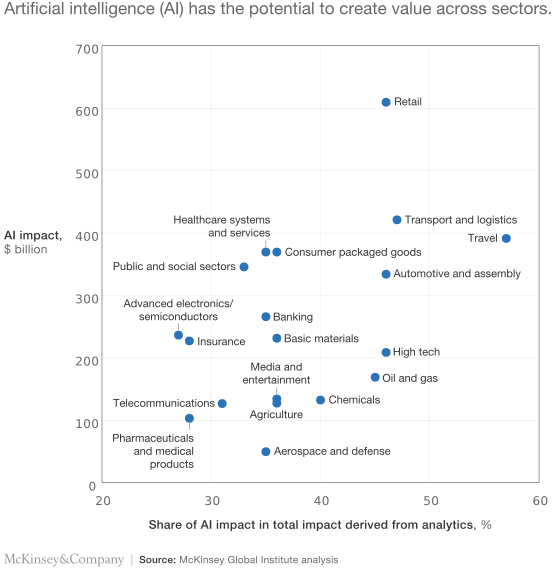
Ethiopia’s Sovereign Wealth Fund Absorbs Eight Public Enterprises into Portfolio Read More »

Agritech firm “enfarm” secures seed funding

Although the value has not been disclosed, this investment will fuel enfarm’s mission to revolutionise agriculture by empowering farmers with data-driven insights to boost yields while minimising environmental impact.

By leveraging AI and the Internet of Things to optimise crop nutrition, enfarm addresses the critical agricultural challenge of inefficient fertiliser use. This practice wastes a staggering $120 billion annually, degrades one-third of global cropland, and contributes to 5 per cent of greenhouse gas emissions. The company’s innovative solution utilises real-time data from soil sensors and smartphone applications. Its platform provides lab-grade precision on NPK readings, coupled with AI-powered actionable recommendations to significantly reduce fertiliser waste and improve crop performance.

Recent field trials on coffee farms in the Central Highlands showcased the power of enfarm’s technology. Farmers achieved a remarkable 30 per cent reduction in fertiliser use, while simultaneously increasing crop yields by 30 per cent. This success has led to rapid adoption by farmers in southern Vietnam, particularly coffee and durian growers.

Khanh Tran, managing partner at Touchstone Partners, said, “We believe that technology can transform the lives of farmers by addressing long-standing challenges in agriculture. By providing farmers with real-time soil data, enfarm’s solution allows farmers to optimise fertiliser use and reduce agricultural waste. By making agricultural production more efficient and sustainable on a larger scale, enfarm boosts productivity while helping farmers reduce costs and improve their livelihoods.”

“We are thrilled to have the support of these leading funds to accelerate our mission of sustainable agriculture,” said Dzung Do Nguyen, co-founder and CEO of enfarm. “This investment will enable us to scale operations, lower product costs, cover more corps, and expand to other ASEAN markets.”

Nguyen further emphasised the urgency of enfarm’s solution. “Climate change is jeopardising traditional farming methods, positioning enfarm as a transformative solution for global agriculture. Low-carbon, high-yield farming practices can meet the 70 per cent increase in food demand forecasted by the FAO by 2050.”

A conference on agriculture cooperation between Ireland and Vietnam was held on September 8 by the Irish Department of Agriculture, Food, and the Marine in collaboration with Vietnam’s Ministry of Planning and Investment’s (MPI) Agency for Enterprises Development.

With financing from local VC firm Ascend Vietnam Ventures (AVV) and Singapore-based VC firm TNB Aura, agritech startup TechCoop Pte. Ltd. secured over $5 million in equity and debt from local banks on March 21. Ethos Ventures, South Korean impact investor MYSC, and Mandala Capital also participated in the fundraising.

Pioneering agritech platform Rize is aiming to make sustainable rice cultivation viable through innovative and data-driven practices following its $14 million Series A funding round.

source

Agritech firm “enfarm” secures seed funding Read More »

The Untold Revolution: How Four Blockchain Giants Are Secretly Reshaping the Future

In the rapidly evolving world of blockchain technology, four innovators are leading the charge in redefining various industries. Web3Bay, Chainlink, IoTeX, and Hedera are pioneering advancements that promise to transform e-commerce, Internet of Things (IoT) applications, data connectivity, and business operations.

Web3Bay is creating waves in the e-commerce sector by implementing blockchain solutions that enhance transaction transparency and security. Their technology is set to revolutionize how online markets operate, providing buyers and sellers with an unprecedented level of trust and efficiency.

Meanwhile, Chainlink is at the forefront of improving data connectivity. By developing decentralized oracle networks, Chainlink ensures that smart contracts can securely connect with real-world data, which is essential for the functionality of various blockchain applications.
IoTeX stands out in the IoT landscape, focusing on integrating blockchain technology with IoT devices. This integration aims to offer more secure and scalable solutions for managing the massive datasets generated by these devices, promising significant advancements in smart home technologies and industrial automation.

Hedera is targeting enterprise applications with its state-of-the-art decentralized ledger technology. By offering a fast, fair, and secure infrastructure, Hedera’s solutions are poised to bring significant improvements in how businesses handle transactions, data security, and digital asset management.

These companies are quietly crafting a future where blockchain is seamlessly integrated into everyday operations, heralding a new era of technological integration and innovation across multiple sectors.

As the blockchain landscape continues to evolve, investors and technology enthusiasts are keenly observing the trajectory of innovations led by companies like Web3Bay, Chainlink, IoTeX, and Hedera. These pioneers are not just reshaping their respective industries but are also influencing broader market trends and investment decisions. Here is a deeper dive into cryptocurrency rate predictions for 2025, investment risks, and the ongoing controversies that surround this disruptive technology.

Cryptocurrency Rate Predictions for 2025
The cryptocurrency market is notoriously volatile, making rate predictions a challenging endeavor. However, experts suggest that as blockchain technology gains mainstream adoption, certain cryptocurrencies tied to groundbreaking projects like Chainlink and Hedera are expected to see significant growth. Chainlink’s decentralized oracle networks, which enhance smart contracts’ reliability and functionality, could lead to increased demand for LINK tokens, potentially driving up their value. Meanwhile, Hedera’s enterprise focus might attract institutional investments, which could bolster the value of its native cryptocurrency, HBAR.

Investment Risks and Considerations
While the potential for high returns is alluring, investing in cryptocurrencies carries substantial risks. Market volatility can lead to rapid fluctuations in asset values, posing a challenge for investors seeking stable returns. Additionally, regulatory changes worldwide can impact cryptocurrency prices and adoption, adding another layer of uncertainty. Therefore, diversification and thorough research are crucial strategies for those seeking to venture into crypto investments.

Pros and Cons of Blockchain Innovations
The innovations driven by companies like Web3Bay, IoTeX, and others offer distinct advantages and some drawbacks:

Pros:
– Enhanced Security: By integrating blockchain with IoT, IoTeX ensures secure data handling, which is critical for managing sensitive information from connected devices.
– Increased Transparency: Web3Bay’s solutions improve transparency in e-commerce transactions, fostering trust between buyers and sellers.
– Improved Efficiency: Hedera’s high-speed transactions and low fees provide an efficient infrastructure for enterprise applications.

Cons:
– Scalability Challenges: Despite advancements, blockchain technologies still face hurdles related to scaling solutions to accommodate widespread usage.
– Complexity for Users: The underlying technology can be complex, posing a barrier to entry for some users and businesses.
– Regulatory Hurdles: As cryptocurrency adoption increases, so does scrutiny from governments, which may lead to restrictive regulations.

Controversies in the Cryptocurrency Sphere
The cryptocurrency industry is not without its controversies. Concerns about environmental impacts, particularly with energy-intensive processes like mining, have sparked debates about the sustainability of blockchain networks. Furthermore, regulatory uncertainty around the world creates an unpredictable environment for businesses and investors alike.

As the blockchain realm advances, navigating these challenges while capitalizing on opportunities requires a nuanced understanding of both technological innovations and market dynamics. For those interested in learning more, resources such as Chainlink, Hedera, and IoTeX’s official websites can provide valuable insights into their ongoing projects and future plans.

In conclusion, as we approach 2025, keeping an informed perspective on these emerging technologies and financial instruments is key to making the most of the evolving crypto landscape.

Andrew Patterson is an accomplished technology writer with a passion for detailing the latest advancements in tech. He holds a master’s degree in Computer Science from the University of Victoria, where he honed his skills and developed his deep interest in technology.

Following his academia, Andrew served in a crucial tech-centric role at Gartner, a renowned research and advisory company. At Gartner, he expanded his knowledge base while gaining firsthand experience with emerging technologies. He leveraged his expertise to write comprehensive product analyses, contributing significantly to the company’s industry guides and reports. Now a revered author, Andrew brings his extensive experience and profound understanding of the tech industry to his writing, providing readers with a comprehensive view of new technologies. His work is essential reading for those keen on understanding the changing face of technology in an ever-evolving digital world.

source

The Untold Revolution: How Four Blockchain Giants Are Secretly Reshaping the Future Read More »

Top 10 Startup Trends (2024 & 2025) – Exploding Topics

With rising interest rates and an uncertain economic outlook, the startup world is currently in flux.
However, startups in certain industries (like AI) are thriving.
From venture capital to generative AI, here are the most important startup trends happening right now:
VC funding for generative AI startups has been climbing over the last 3 years.
undefined
However, in late 2023 and early 2024, VCs have been making big bets on AI startups.
Here are a few key examples:
undefined
Search volume for “Anthropic” are up more than 2,850% since 2019.

Despite this inflow of cash, many are predicting a slowdown in generative AI funding sometime in 2024.
One reason is purely based on the short supply of high-powered chips. The shortage is so severe that black markets are popping up.
Another potential downfall for generative AI startups is uncertain consumer interest.
Surveys show just 21% of Americans have used an AI program in the past six months.
undefined
More than three-quarters of Americans have not used an AI-powered platform in the past six months.

Only 31% of US adults say society is ready for widespread use of AI.
The dominance of well-funded tech giants is another factor to consider.
In 2022 alone, the big five tech companies spent $223 billion on AI research and development and $161 billion in capital spending.
undefined
Spending on AI among the Big Five has been climbing steadily since the early 2010s.

Today’s agricultural producers are looking to get more out of the land while also protecting it from damage.
That’s where agtech startups come in.
With tools focused on farm data and precision agriculture, these firms are leading the charge for regenerative agriculture.
undefined
Search interest in “regenerative agriculture” is up nearly 579% over 5 years ago.

There are nearly 300 agtech startups in the US that are focused on AI. That’s out of a total of about 1,400 agtech startups globally.
undefined
Search interest in “agriculture AI” is up more than 658% compared to 5 years ago.

GroGuru is a startup using AI to optimize the use of water in agriculture.
Their solutions are currently in use by 300 customers spanning more than 200,000 acres across the United States.
The company is still in the early stages of development with just $4 million in total funding.
With $16 million in total funding, Aigen is another AI-powered agtech startup.
The company manufactures autonomous robots that roll through fields to eliminate weeds and analyze the crops.
undefined
Aigen’s robots independently navigate fields while running on 100% renewable energy.

Their solution has the potential to become a sustainable replacement for the billions of pounds of pesticides that are annually deployed in the agriculture fields.
Several climate tech startups have seen massive growth and funding rounds over the last 18 months.
undefined
Search volume for “climate tech” is up nearly 421% in 5 years.

VC investment in startups specializing in carbon and emissions reduction technologies reached a record high — $7.6 billion — in the third quarter of 2023.
undefined
Investment in carbon and emissions reduction technology soared in 2023.

Startups in green mining and energy-efficient buildings saw record amounts of funding in quarter three as well. Green mining startups brought in $394.9 million while energy-efficient buildings raised $638.7 million.
However, these record-breaking numbers come as overall investing in climate tech is down.
PwC reported that private equity investment and grant funding in climate tech is down more than 40% year-over-year in 2023.
But, in comparison, private investment across all sectors is down 50% YOY.
However, the sector is responsible for a growing percentage of private market equity as compared to total startup investments.
In 2023, more than 10% of all startup investments went to climate tech firms. That was up from 7.22% in 2020.
undefined
Climate tech’s percentage of total startup investment funds has been climbing for the past 10 years.

As of May 2024, there were well over 100 unicorns in the climate tech space for a total value of $200 billion.
Electric Hydrogen is one of the latest startups to reach unicorn status.
The Massachusetts-based tech company is focused on manufacturing low-energy, cost-efficient electrolyzers that are necessary to split H20 and collect hydrogen.
undefined
Search volume for “green hydrogen” has jumped more than 1,220% in the past 5 years.

Electric Hydrogen raised $380 million in a Series C funding round in October 2023, bringing its valuation to $1 billion.
Commonwealth Fusion Systems is another unicorn. The company has raised $2 billion in funding.
undefined
Commonwealth Fusion Systems has received funding from Bill Gates, Tiger Global Management, and others.

Fusion energy is at the center of their operations. It’s a specialized type of nuclear energy that produces more energy than typical nuclear sites but does not create nuclear waste or greenhouse gasses.
The company is currently constructing a SPARC facility. According to the company, this will house the first-ever net-energy fusion machine.
In 2025, the company plans to begin building a full-scale fusion power plant.
Estimates showed that nearly one in five new cars sold in 2023 were electric. That meant the total units sold was an estimated 14 million+.
undefined
The number of electric vehicles sold rose sharply in the early years of this decade.

From Tesla to big-name domestic and foreign automakers, electric vehicles are selling but more slowly than experts predicted.
One reason for the slow roll-out is that the network to support electric cars is lacking.
For instance, reports suggest that New York City alone is 40,000 charging plugs behind demand.
Across the US, there are approximately 130,000 individual charging ports but 145,000 gas stations with multiple pumps.
This lack of infrastructure is proving to be an opportunity for startups.
ElectroTempo, a Virginia-based startup, has found its niche in providing software and analytics solutions to predict demand for charging stations and suggest the most cost-effective ways to build out infrastructure.
The company’s most recent funding round closed in August 2023 with $4 million in seed funding.
undefined
Software from ElectroTempo can map EV charging demand in any location.

In another example, ItsElectric is a startup that’s installing curbside EV chargers on city streets to provide charging opportunities to drivers who don’t have a garage.
undefined
Search interest in “EV charging” has been climbing since 2021.

Instead of going through the process of working with utility providers, ItsElectric partners with owners of residential buildings. The charging stations are located on the sidewalk and pull power from the building’s electricity.
undefined
Curbside EV chargers from ItsElectric are operated via the driver’s smartphone.

The company reports that they have orders for hundreds of chargers in various cities.
And, there’s the final step in EV operations: disposing of old batteries.
Estimates show that 12 million tons of batteries will be retired by 2030.
Posh Robotics is one startup that’s looking to put those batteries back to work.
To start, the company produces battery packs with the intent of recycling them in the future.
When the batteries are ready to be recycled, Posh automates the process with computer vision and robotic arms, turning a manual and time-intensive process into one that’s quick and safe.
The battery’s components can then be reused for other functions.
undefined
The automated disassembly process eliminates human exposure to hazards.

The company brought in $3.8 million in seed funding in June 2022.
The biotech industry is already valued at $1.55 trillion and it’s expected to grow at a CAGR of nearly 14% through to 2030.
undefined
The biotech industry is showing sustained growth.

And that number may grow as biotech startups make more advances in diagnosing, treating, and preventing disease.
Biotech startups are already seeing a lot of interest from investors.
When considering the 130 US-based startups that posted funding rounds of $100 million or more in 2023, biotech startups were responsible for 34 of those rounds.
Drug discovery is one area that’s seeing a lot of attention because it incorporates AI/ML technology.
undefined
Search interest in “AI drug discovery” has increased 529% since 2019.

One survey reported that 70% of industry respondents who do not currently use AI said they expect the technology to drive a significant or transformative impact in drug discovery in the next five years.
Evozyne, founded in 2020, is one startup aiming to do just that.
The biotech firm has created algorithms that enable the rapid studying of proteins, simulating their evolution over millions of years and identifying new roles in drug development.
undefined
Evozyne’s biotech developments are focused on proteins. 

Evozyne recently closed a Series B investment round worth $81 million.
One of the most successful startups in the AI biotech space is Genesis Therapeutics.
undefined
Genesis Therapeutics has created its own AI platform that specializes in small-molecule drug discovery.

Their technology is centered on using AI to create 3D modeling and molecular simulations.
Genesis’ most recent funding round netted $200 million.
The largest Series C funding round for a biotech company in 2023 came from Generate:Biomedicines.
The $273-million funding round brought the company’s total amount of funding to $700 million.
Generate:Biomedicines says their platform can generate custom protein drugs using a combination of machine learning and bioengineering.
Their first human trial, an antibody therapy for COVID-19 that took just 18 months to develop, began in mid-2023.
The company hopes to have another drug, a medication for severe asthma, in human trials in 2024.
In the final quarter of 2021, startup funding for metaverse companies topped $2 billion.
Fast forward to the second quarter of 2023 and funding plummeted to just $300 million.
undefined
Funding for metaverse startups surged in the final months of 2022 but sharply declined in 2023.

Data shows that funding for metaverse companies has dropped as investors flock to funding generative AI projects.
undefined
Funding for metaverse startups has decreased while funding for generative AI projects has increased.

Despite this, predictions show the total value of the metaverse market could grow by a CAGR of 48% through 2030 to land at $1.3 trillion.
Some startups are betting on this growth projection and entering the market despite funding challenges.
Take Futureverse, for example.
The company, formed in 2022, closed a $54-million Series A funding round in mid-2023.
Futureverse’s platform is broadly applicable to the metaverse. It uses AI to generate all sorts of metaverse content like music, characters, and animations.
undefined
Search volume for “metaverse marketing” has been up and down since 2022.

They’ve already launched AI League, an AI-powered soccer game available on Android and Apple devices.
undefined
The players in AI League feature custom wearables and AI skills.

In another example, Geeiq is a metaverse digital metrics and intelligence startup.
undefined
Geeiq’s platform is especially relevant for businesses that need data intelligence from Roblox.

The company has already partnered with big names in fashion like Ralph Lauren, Gucci, and Tommy Hilfiger.
In September 2023, Geeiq completed an $8.2 million Series A funding round.
The future of metaverse startups remains unknown and tech experts are split on their predictions, too.
In a survey from the Pew Research Center, 54% of tech insiders say they expect the metaverse to be a refined platform that’s truly immersive by 2040. However, 46% of respondents said this will not happen by 2040.
Like many other startup sectors, investments in space tech have been impacted by the current economic downturn.
However, total investment in the second quarter of 2023 totaled $818 million. That was double that of the first quarter. The median deal size also doubled during that time.
And big funding rounds came in for three growth-stage companies:
undefined
Search interest in “Astranis” has jumped nearly 363% in the past 5 years.

Industry experts say satellite imagery startups seem to be the sure bet of this sector as investors see them as safe and demand is relatively predictable.
Deloitte reports that the amount of data moving between Earth and space will total 500 exabytes by 2030. That’s a 14x increase over 2020.
undefined
Deloitte notes that challenges associated with space tech have diminished significantly in recent years.

Investment data backs up predictions regarding the importance of satellite technology.
In the past two years, investment in satellite-focused companies has amounted to nearly 30% more capital than investment in launch-oriented firms.
undefined
Investments in the satellite sector are growing faster than investments in the launch sector.

Pixxel is a satellite startup that’s building space satellites so powerful they can identify the tree species present in a forest.
In fact, the company says its satellites are 10 times more powerful than traditional satellites that are currently deployed in orbit.
The startup has raised $71 million to date, including a $36 million in a Series B funding round in June 2023 that was led by Google.
There’s also Seattle-based Starfish Space, a startup that aims to provide satellite maintenance at a reasonable price.
undefined
Starfish Space is focused on finding a way to repair satellites in space. 

The company’s first major objective is to dock two commercial satellites in orbit.
However, their first mission nearly ended in catastrophe. A glitch caused their spacecraft to go tumbling through space but engineers on the ground were able to pull it back under control.
Still, Starfish has garnered about $22 million in funding and was recently tapped by NASA to investigate the possibility of using Starfish technology to inspect space debris up close.
Crunchbase reports that seed and venture funding to drone-related startups eclipsed $1.51 billion in the first seven months of 2023.
That number is on track to surpass 2022 when the annual equity funding hit $1.6 billion.
Drone startups specialize in everything from light displays to defense weaponry and surveillance to the delivery of goods.
undefined
The use of drones is expanding to a variety of industries.

In the United States alone, there are more than 1,300 drone startups.
Zipline is one of the most successful.
The startup offers fulfillment and drone delivery to organizations and to residential homes. Their service delivers consumer healthcare products, restaurant orders, grocery items, and urgent public health products.
So far, they’re operational in seven countries and have already flown 59 million miles.
undefined
Zipline has drone delivery systems on three continents. 

In August 2023, the company raised $330 million and was valued at more than $4 billion — the highest valuation of any drone delivery company in the world.
Zipline is also expanding deliveries in the US.
A Seattle-based pizza restaurant, a medical courier service, and GNC recently announced they would partner with Zipline for deliveries.
Skydio is another billion-dollar drone startup.
undefined
In the past 5 years, the search volume for “Skydio drones” has grown 6,200%.

Valued at $2.2 billion, the firm closed a $230 Series E funding round in early 2023.
That valuation is double what it was just two years ago and the company has reported 30x growth since 2020.
As the largest drone manufacturer in the United States, Skydio builds drones for a mix of functions — government, consumer, and enterprise. The drones perform a variety of tasks such as bridge inspection, battlefield surveillance, search and rescue, power plant inspection, and more.
Startups are also developing drones for indoor use, especially for the purpose of tracking warehouse inventory.
Verity is one such startup that’s seen recent success with investors.
The firm raised $43 million in 2023.
Its small, nimble drones are flying in 16 IKEA warehouses across Europe.
undefined
Verity’s drones track warehouse inventory.

Funding for startups headed by Blacks, Latinos, women, and other minorities is remarkably low. But some in the investing space are hoping to change that.
McKinsey research shows the average startup led by white males receives more than $210 million in total funding while the average startup led by minority founders garners $91.1 million, just 43% of the funding given to startups led by white males.
undefined
Startups founded by underrepresented demographic groups receive dramatically less funding than businesses founded by white men.

In particular, startups led by Latinos are impacted by a lack of private equity and venture capital.
Even though Latinos in the startup community represent a combined value of $2.6 trillion, Lainto entrepreneurs receive less than 1% of total invested capital.
The data is similar when looking at female-led startups.
Pitchbook reports that startups founded by women accounted for just 2.1% of total capital invested in venture capital-backed startups.
undefined
More VC capital is invested in startups that have both female and male founders than in startups led only by females.

In 2022, that amounted to $4.3 billion in 926 deals.
However, most of the money marked as going to “diverse founders” is going to white women.
Research from BBG Ventures found that 79% of “diverse founders” seed funding went to white women.
Change does appear to be on the horizon.
In October 2023, California passed a law requiring VC firms to report data regarding the diversity of the startups they’re funding.
The law goes into effect in 2025.
On the other side of the country, the New York City Economic Development Corporation is launching the Venture Access Alliance — a group of 70 investors committed to funding startups with diverse leadership.
undefined
New York City’s Venture Access Alliance is dedicated to incorporating diversity into venture investments.

Change is coming overseas, as well.
Unconventional Ventures is a firm recently launched in the Nordics region. They’re looking to invest in diverse startups in healthtech, food tech, fintech, and sustainable fashion.
The firm just wrapped up its second close on a $32 million fund.
With the uncertainty surrounding the current economy, startups in need of funding are increasingly turning toward unconventional methods.
Non-dilutive funding is becoming a popular option.
This type of funding includes options like loans, grants, and government subsidies. And startups don’t have to give up any of their ownership to secure the funds.
For example, many states and metro areas offer non-dilutive startup funding to spur economic development.
Alabama Launchpad is one such program that offers up to $150,000 in non-dilutive funding through four startup competitions per year.
undefined
Alabama Launchpad hosts four startup competitions per year.

So far, the organization has funded 117 startups with $6.2 million.
On the other hand, some startups, especially growth-stage startups, are using venture debt as a way to supplement their financing.
Although venture debt took a huge hit when Silicon Valley Bank went under, demand is still there.
One private credit marketplace that grants venture debt deals up to $20 million says they’re handling 4x as many startups in 2023 as compared to 2022.
undefined
Venture debt has become a popular financing option for startups.

Simple agreements for future equity (SAFE) rounds are also becoming a valuable tool for startups.
SAFE funding doesn’t require a startup to settle on a valuation. Instead, the price is fixed in a future equity round.
This has become especially relevant in recent months as valuations have been under pressure.
Many firms believe SAFE funding is the best kind of deal for early-stage funding rounds.
One AI firm focused on the construction agency, Togal.AI, raised $5 million in a SAFE round in March 2023.
There’s also been an increase in crowdfunding for startups.
StartEngine is a crowdfunding platform that allows anyone to invest in startups.
undefined
Everyday investors have put more than $1 billion into startups via the StartEngine platform.

In 2023, StartEngine itself was valued at $1.32 billion.
During the year, it also acquired another investment crowdfunding platform called SeedInvest.
Timeplast, a startup that’s developed a type of plastic that completely dissolves in water, has raised $4.3 million on StartEngine.
Legion M, a film and television startup, has raised more than $3.5 million on the platform.
undefined
Investors can get started with Legion M for just $39.60.

There you have it: the 10 biggest startup trends for 2024 and beyond.
It’s clear that tech startups in the AI space are the most popular right now. But if interest in AI wanes in the coming months, that could change.
Still, tech startups in other sectors like agriculture, space, and climate have the potential to make big moves in the near future.
Either way, new technologies and disruptive ideas continue to spur massive changes in the startup world.

source

Top 10 Startup Trends (2024 & 2025) – Exploding Topics Read More »